

A BTech in Mechanical Engineering can help you get jobs in manufacturing, automotive engineering, design, energy, and several other industries. It can also open doors to software and other fields, depending on your skills and preparation.
Your college, technical knowledge, practical experience, and the skills you build during the four years can shape your career opportunities.
This guide covers the subjects you will study, the skills employers value, what to expect from campus placements, and how to choose a career path.
What BTech Mechanical Engineering Actually Is?
Mechanical Engineering is one of the oldest engineering branches. A BTech programme in Mechanical Engineering covers three key areas.
The first is physics-based engineering. It covers thermodynamics, fluid mechanics, heat transfer, and solid mechanics. These topics explain how energy, forces, and materials behave. They are the foundation for understanding how machines work.
The second is design and manufacture. Students learn machine design, manufacturing processes, CAD/CAM, and metrology. These subjects teach students how to turn an idea or drawing into a finished part, choose suitable materials, and meet specified design tolerances.
The third is systems thinking. It includes machine theory, dynamics, control systems, and industrial engineering. These subjects help students understand how mechanical components work together, how motion is controlled, and how production systems can run efficiently.
By studying these three areas, students gain valuable skills to understand physical systems from first principles, design mechanical components, and manage their manufacturing.
But the problem is how colleges teach those subjects. At many colleges, theoretical concepts are not connected well to physical applications. Design subjects are taught without industry-standard software and real project constraints. As a result, graduates understand the theory but struggle to apply it to unfamiliar problems.
During the requirements, many mechanical engineering graduates struggle to connect theory and practice.
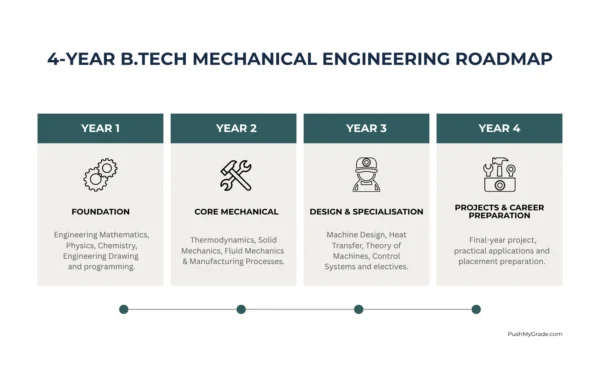
4-Year BTech Mechanical Engineering Roadmap
Year One: The Foundation
The first year of BTech Mechanical Engineering covers many common subjects across colleges. These include Engineering Mathematics (Calculus, Linear Algebra, and Differential Equations), Engineering Physics, Engineering Chemistry, Engineering Drawing, and an introduction to programming.
These subjects build the foundation for the rest of the course. Calculus appears again in subjects such as Thermodynamics and Fluid Mechanics. Linear Algebra provides the mathematical foundation for understanding FEM (Finite Element Method), which engineering software such as ANSYS uses. Differential equations are the language of dynamic systems.
Engineering Drawing teaches you to read and prepare technical drawings. This skill helps engineers communicate clearly with manufacturing teams. Programming is another subject that you should learn attentively. The logic you learn in C can help you later with MATLAB, Python, and simulation scripting.
Year Two: The Core of Mechanical Engineering
Semesters 3 and 4 introduce the core subjects of BTech Mechanical Engineering. You begin to understand how machines work, how materials respond to loads, and how engineering principles apply to real systems.
Thermodynamics is one of the first challenging conceptual subjects. Students learn the first and second laws, Rankine and Brayton cycles, and entropy. These concepts become easier to understand when connected to a real power plant or a car engine. If you can visualise a T-s diagram while solving a problem, it shows that you understand the concepts. This understanding will help you tackle more advanced subjects in later semesters.
Solid Mechanics is also known as Strength of Materials. It teaches how materials behave under loads. You learn how materials respond to stress and how loads affect their strength. These concepts underpin almost every design decision in mechanical engineering. Understanding how and why components fail helps engineers design safer, more reliable parts.
Fluid Mechanics introduces Bernoulli’s equation, flow regimes, and pipe-flow analysis. Although some students find the subject difficult or uninteresting, it has applications across many industries. Fluid Mechanics is used in power plants, oil and gas systems, HVAC, aerospace, and automotive cooling systems.
Manufacturing Processes introduces casting, forging, welding, machining, and forming. You learn how raw materials become finished products. This subject is relevant to GATE preparation and PSU recruitment interviews. It also helps future design engineers understand manufacturing constraints. A component that looks good on paper may still be a poor design if it cannot be manufactured economically.
Year Three: The Move Towards Specialisation
The third year takes you deeper into Mechanical Engineering. You begin applying concepts from earlier semesters to design problems, mechanical systems and specialised subjects.
Machine Design brings together Solid Mechanics, materials science and manufacturing knowledge. You learn to design actual components such as shafts, gears, bearings, springs and fasteners. The focus shifts from analysing existing components to designing parts that meet specific performance and manufacturing requirements.
Heat Transfer builds on Thermodynamics. You study conduction, convection, radiation and combined heat transfer problems. It involves real systems such as finned heat exchangers and engine cooling jackets. Here, you understand how thermal systems are designed.
Theory of Machines covers the kinematics and dynamics of mechanisms. Topics include velocity and acceleration analysis, gear trains, governors and vibrations. Vibration analysis has practical applications in rotating machinery, bridges, vehicles and aircraft structures. It helps you identify problems and reduce the risk of mechanical failure.
Control Systems may feel closer to Electrical Engineering, but they have many applications in Mechanical Engineering. CNC machines, robots, HVAC controllers, and automotive cruise control are all mechanical systems with control loops. Control systems knowledge can help mechanical engineers pursue careers in automation and robotics.
Electives often begin in Semester 5 or 6. IITs and leading NITs offer electives in areas such as Finite Element Analysis, Robotics and Mechatronics, Computational Fluid Dynamics (CFD), Renewable Energy Systems and Automotive Engineering. Available subjects and teaching depth vary by college. Choose electives that align with where you want to work, not the easiest ones.
Read More: BTech Computer Science and Engineering: Courses, Careers & Scope
Year Four: The Final Step Towards Your Career
The final-year project can be one of the most valuable parts of your degree. What you gain depends on your college, the project you choose, and the effort you put in.
At IITs, some final-year projects involve faculty research, industry collaboration, or simulation work that may lead to a research publication. Project opportunities vary between colleges, so focus on what you can learn and build. If you have a choice, choose a project that solves a practical problem or explores an area you want to work in.
Examples include a CFD simulation of a heat exchanger with quantified results, a structural analysis of a component with FEM, or a working prototype of a mechatronic system. These projects provide practical experience and useful examples to discuss during job interviews.
Campus placements begin in the 7th semester at most colleges. Core companies (automotive OEMs, aerospace firms, manufacturing companies, PSUs) generally recruit fewer graduates than the IT sector. So, competition for core engineering roles can be different.
The balance between core and non-core recruits varies between colleges. Compare placement records and the recruiter lists before choosing any college.
The Right Subjects for Different Mechanical Engineering Careers
A BTech in Mechanical Engineering covers more than 40 subjects across eight semesters. Not all of them are equally important for your career goals.
For Design and R&D Roles
Machine Design, Solid Mechanics, Materials Science, Finite Element Analysis (FEA), and Computer-Aided Design (CAD) are important for these roles. Practical experience with tools such as SolidWorks, CATIA or NX is valuable for design roles. You should be able to create CAD models, perform basic FEM simulations in ANSYS and read engineering drawings that use Geometric Dimensioning and Tolerancing (GD&T). These practical skills can strengthen your job profile alongside your CGPA.
For Manufacturing and Production Roles
Focus on Manufacturing Processes, Industrial Engineering, Quality Control, and lean manufacturing principles. Automotive and consumer goods manufacturers need engineers who understand production. Know the differences between casting, forging, and machining; understand tolerances and surface-finish requirements; and read process flow charts. These skills help you understand how products are manufactured and how to address production problems.
For Thermal and Energy Roles
Thermodynamics, Heat Transfer, Fluid Mechanics, and Power Plant Engineering form the foundation for these careers. Oil and gas companies, NTPC, BHEL, and other process industries look for candidates with a strong grasp of these subjects. For example, you should be able to explain the Rankine cycle and how it applies to a particular power plant configuration. Connecting theory with real systems helps you prepare for technical interviews and engineering work.
For GATE and PSU Recruitment
The GATE Mechanical Engineering syllabus covers many of the core subjects taught during the degree. High-weightage topics include Thermodynamics, Fluid Mechanics, Solid Mechanics, Machine Design, Manufacturing, Theory of Machines, Engineering Mechanics, and Industrial Engineering. GATE preparation requires a strong understanding of fundamental concepts and regular problem-solving practice. Build a solid foundation before moving to more advanced problems, and practice regularly to improve your speed and accuracy.
Technical Tools Every Mechanical Engineering Student Should Learn
Mechanical engineering jobs in India often list software skills such as SolidWorks, CATIA, AutoCAD, ANSYS or SolidWorks Simulation, and increasingly, MATLAB or Python.
Colleges introduce students to these tools through laboratory sessions, but the depth of training varies. You may learn to create a basic model or run a simple simulation, but employers often expect you to apply these tools to practical engineering problems.
AutoCAD
AutoCAD is widely used to prepare 2D drawings for engineering projects. Manufacturing and construction teams use CAD software to create and revise technical drawings. You should be able to create, read, and edit technical drawings for many engineering roles.
SolidWorks
SolidWorks is a 3D CAD tool used for parametric modelling, assemblies and detailed engineering drawings. SolidWorks Simulation supports finite element analysis (FEA), including stress analysis. Many companies rely on SolidWorks for product modelling and design work. If you want to learn one 3D CAD tool in depth, SolidWorks is a practical starting point.
CATIA
CATIA is a popular design tool in automotive and aerospace engineering. It is especially used for complex surface modelling and product design. Maruti Suzuki, Tata Motors, Mahindra, Airbus, Boeing, and their Indian vendors all use CATIA for complex surface modelling. It’s harder to learn than SolidWorks. If you’re interested in automotive or aerospace design, learning CATIA can be useful.
ANSYS
ANSYS is a widely used finite element analysis (FEA) and computational fluid dynamics (CFD) simulation platform. It includes stress analysis, thermal analysis, fluid flow simulation, and structural dynamics. College laboratories may provide access to the software, but practical experience depends on how extensively you use it.
Learn to set up simulations, interpret results correctly, and validate them with hand calculations where appropriate. These skills can help you prepare for simulation-focused engineering roles.
MATLAB and Python
MATLAB and Python are useful for data analysis, numerical calculations, and simulation or control systems. For example, a mechanical engineer can write a Python script to process sensor data, or build a MATLAB model of a dynamic system. These skills can expand your career options across several engineering fields.
Regular practice helps you become confident with these tools. Self-study, online courses and training programmes from software vendors can help you develop your skills. You can also work on personal or group projects that involve practical engineering problems.
For example, create a CAD model with detailed drawings, run a simulation and check its results, or write a script to analyse engineering data. These projects give you concrete examples to discuss during interviews and help demonstrate your skills.
Placement Figures of Mechanical Engineering in India
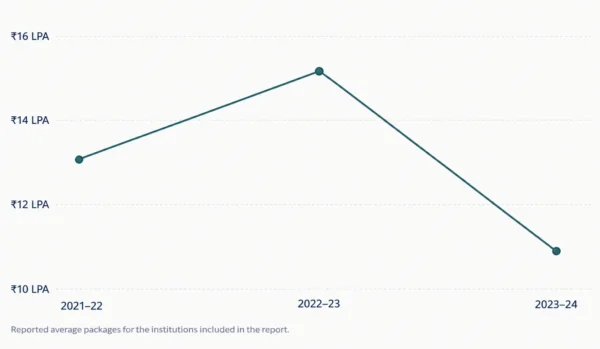
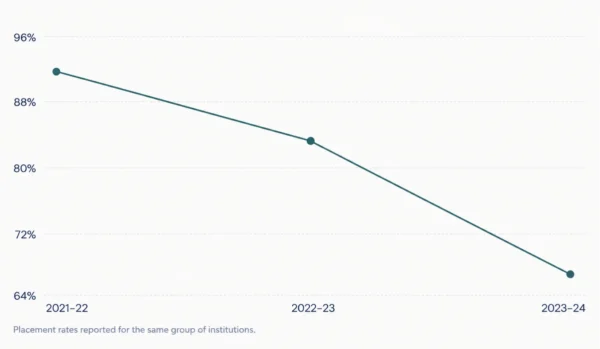
Careers360 analysed Mechanical Engineering placement data from 30 engineering institutions (14 IITs, 14 NITs and two IIITDMs). The figures below show changes in average packages and placement percentages across three academic years.
| Year | Average Package | Placement Rate |
|---|---|---|
| 2021–22 | ₹12.91 LPA | 90.05% |
| 2022–23 | ₹14.88 LPA | 83.17% |
| 2023–24 | ₹11.03 LPA | 67.75% |
These figures cover the 30 institutions included in the report, so they shouldn’t be treated as representative of every engineering college in India.
Placement outcomes also differ between colleges. In 2023–24, IIT (BHU) Varanasi reported a Mechanical Engineering placement rate of 64.38%. At NIT Goa, the rate was 21.70%, with an average package of ₹6.5 LPA.
Mechanical Engineering graduates face a different recruitment landscape from students in other branches. Core engineering opportunities depend on industry demand, available roles, and the skills employers require. Some graduates also apply for IT jobs, which can bring a different set of hiring conditions.
These figures show why you should look at placement rates, average packages, and recruiter lists over a college’s reputation.
Source note: Careers360 placement report; figures cover the 30 institutions included, not every engineering college in India.
Three Career Paths after BTech Mechanical Engineering
Path 1: Core Manufacturing and Design
Common roles in this path include design engineer at Tata Motors, thermal engineer at L&T, manufacturing engineer at Bosch, and project engineer at Caterpillar.
These jobs are available, but in smaller numbers. Entry-level packages at companies outside the top OEMs are often around ₹3.5–6 LPA. Salary growth depends on the company, available opportunities, and how quickly you develop your technical skills.
Major employers in core Mechanical Engineering include BHEL, L&T, Tata Motors, Mahindra, Maruti Suzuki, ONGC, Bosch India, Cummins, Honeywell, Caterpillar and GE Global Research. Bosch and GE also hire engineers for R&D and other technical roles through campus and off-campus recruitment.
Strong CAD skills, relevant project work, and internship or industrial training experience can help you stand out as a fresher. Choose projects that match your intended field, whether that is product design, manufacturing, thermal engineering, or another core discipline.
Path 2: PSU Jobs through GATE
Public Sector Undertakings (PSUs) provide structured pay and relatively strong job security in India.
PSUs such as NTPC, BHEL, ONGC, IOCL, GAIL, HAL, ISRO, DRDO, Power Grid, BPCL, and SAIL have recruited Mechanical Engineers through GATE. Starting compensation, including basic pay, dearness allowance (DA), house rent allowance (HRA), and other allowances, can total around ₹8–14 LPA, depending on the organisation and pay grade. The work can involve power generation, oil refining, aerospace manufacturing or defence systems.
PSU recruitment is highly competitive and requires consistent preparation. If you plan to take GATE, start preparing by your third year or earlier. This gives you more time to prepare, practise problems, identify weak areas, and revise the syllabus before the exam.
GATE is no longer the only recruitment route for PSU jobs. Some organisations, including ONGC, BHEL, HPCL, SAIL, and Coal India, use computer-based tests for hiring. Check each organisation’s latest recruitment notification to confirm its selection process.
Path 3: Electric Vehicles, Robotics and Automation
India’s shift towards electric mobility and industrial automation is creating new opportunities for Mechanical Engineering graduates.
Opportunities include battery thermal management, powertrain design, EV chassis design, lightweight materials, and manufacturing processes for EV components. These roles build on traditional mechanical engineering principles and apply them to EV requirements. Tools such as SolidWorks, CATIA, and ANSYS are also useful in this field.
Robotics and automation offer another career direction for Mechanical Engineering graduates. Companies such as Siemens, Mitsubishi Electric, Honeywell, and ABB, along with smaller automation firms, recruit engineers for mechatronics, programmable logic controllers (PLCs), and control systems.
Students can prepare for these roles by combining strong mechanical engineering fundamentals with programming and practical project experience. Python or MATLAB skills can help, and projects using platforms such as Arduino or Raspberry Pi can provide hands-on experience. An understanding of control theory is also valuable, particularly for robotics and automation.
Read More: Top Private Engineering Colleges in India
When Mechanical Engineers Choose IT
Many Mechanical Engineering graduates from non-IIT colleges start their careers in IT companies. TCS, Infosys, Wipro, Cognizant, and Tech Mahindra all hire engineering graduates from different branches for their training programs.
Starting salaries at these companies are often around ₹3.5–4.5 LPA, depending on the role and recruitment programme. Initial work may involve software testing, process support or IT services delivery. These roles have little direct connection to core mechanical engineering.
Some students see this move as a setback, but it is worth looking at the decision more carefully.
If your college has limited placement opportunities, joining an IT services company can be a practical starting point. Use your first two years to build programming skills and gain experience that can help you move into other roles. Later, some graduates move into product companies, industrial automation firms, or EV startups, where they can combine their engineering background with software skills.
The risk is staying in a role without building transferable skills. Spending years in a service desk position without gaining relevant technical experience can limit your future options.
If you are studying Mechanical Engineering at a mid-tier college, it makes sense to have an IT option ready if core engineering placements do not meet your expectations.
What Makes You A Successful Mechanical Engineer?
You can stand out from other graduates by combining classroom learning with practical skills and early career planning.
You learn industry tools before placement season. If you start learning SolidWorks and ANSYS in your second year and use them in projects or internships during your third year, you will have more time to build practical experience. You can also demonstrate these skills in interviews. Learning these tools takes time, so starting early is better than rushing through tutorials right before placements.
You gain experience in a real engineering environment. An internship at a manufacturing plant, design firm, or R&D team can offer practical exposure that a short online course cannot fully replace. Working with experienced engineers helps you understand how they handle engineering tasks in practice. These internships are harder to get, but the experience can strengthen your applications and interview responses.
You treat GATE as a planned career option. Preparing for GATE with a clear goal, such as pursuing an MTech or applying for PSU recruitment, helps you organise your preparation. The exam can open specific academic and career opportunities. Starting early gives you more time to build a strong foundation in core subjects and practise exam questions.
You build skills beyond the college curriculum. Your degree teaches engineering principles, but many roles also require specific tools to solve practical problems. You can bridge this gap through self-study, weekend projects, and real-world problem-solving. This helps you demonstrate skills beyond your academic coursework and answer technical interview questions with greater confidence.
How College Choice Shapes Your Mechanical Engineering Career
The career paths discussed above can be easier to pursue at colleges with strong placement records and established industry connections.
Leading IITs and NITs often have good connections with recruiters such as Bosch, GE, Boeing, NTPC, ISRO, L&T and Tata Motors. These connections can create more opportunities for graduates to enter core engineering roles. Students with similar skills at mid-tier private colleges may have fewer core engineering companies recruiting on campus. This can affect placement rates, the balance between core engineering and IT jobs, and starting salaries.
That does not make a Mechanical Engineering degree from a mid-tier college worthless. Students can strengthen their career prospects through personal projects, off-campus internships, GATE preparation and practical skills relevant to their chosen field.
The degree offers the same syllabus almost everywhere, but placement opportunities can vary considerably. Before choosing a college, check the placement data for its Mechanical Engineering graduates. Pay close attention to the placement rate, median salary, and recruiter list.
The highest package rarely reflects what most Mechanical Engineering graduates earn. A few high salaries can also raise the reported average. Look at placement rates and median salary alongside the highest package for a more realistic picture of career outcomes.
Data sources: Careers360 Placement Report of Mechanical Engineering Graduates, NIRF 2025 placement submissions by IIT Madras, IIT Delhi, IIT Bombay, NIT Trichy; IIT BHU placement statistics 2023-24