

Every year, around 15 lakh students sit for JEE Main. Most of them have one real question: which engineering branch should I pick?
Most students Google the answer and end up with one answer: “CSE is the best.” After several similar articles, they are often more confused than before. The problem is not the question. It is the way the question is usually answered.
Most engineering branch guides follow the same template: a list of branches, a broad salary range that tells you nothing, a few lines about “future scope,” and a conclusion that says “follow your passion.” No trade-offs, no real placement outcomes and no reliable data. No honest discussion about what placements in branches such as Civil Engineering actually look like at an IIT.
This article takes a more practical approach. It looks at the major engineering branches through real placement outcomes, trade-offs and available data so you can make a more informed choice.
What “Core Branches” Actually Means
In any JEE counselling session, you’ll hear someone call a branch “core” as if it were a badge of honour. Usually, they mean Mechanical, Civil and Electrical Engineering — the three traditional branches that have played a major role in building India’s physical infrastructure.
That’s the accurate historical definition. UPSC’s Engineering Services Examination (ESE) still recognises four engineering branches: Civil, Mechanical, Electrical, and Electronics & Telecommunication. These are long-established fields with roots that go back well before computers became widespread.
Here’s where students get confused. “Core branch” has also become casual shorthand for a branch that is harder to place in campus recruitment. That isn’t the term’s historical meaning, but it reflects a real observation. Mechanical and Civil graduates often face harder campus placement odds than CSE peers. We’ll look at the placement data later.
Computer Science Engineering (CSE) sits somewhere in between. Technically, it is not one of the original traditional branches. Still, strong JEE cutoffs, high seat demand and strong industry demand have made it the default choice for many high-ranking students. In terms of student preference, it now carries the status of a core branch while behaving more like an emerging field in the job market.
The third category is newer specialised branches: AI & ML, Data Science, Robotics, Biomedical, Aerospace and Chemical Engineering. Some old branches, such as Chemical and Aerospace Engineering, are actually well-established disciplines with long-standing career paths. Others, such as AI Engineering and Data Science Engineering, are newer degree labels attached to skills that the industry is actively hiring for.
Understanding this three-category map is more useful than simply following the ranked list of engineering branches.
Branch By Branch: What The Actual Data Shows
Civil Engineering
Civil is the most complicated branch to discuss honestly. India has enormous infrastructure needs. The government continues to invest heavily in metro expansion, national highway upgrades, dam modernisation and smart cities. So the overall demand for civil engineers is real. But campus placement data tells a different story.
Across 10 IITs in 2020–21, only 57% of Civil Engineering graduates secured campus placements — the lowest rate among any branch. At IIT Patna, just 30% of Civil Engineering students were placed that year compared with an overall college placement rate of 68%. By 2025, IIT Roorkee’s Civil Engineering placement rate was 65.12%. In the same season, its Electrical Engineering branch recorded a 95.8% placement rate.
The salary gap is also significant. At IIT Delhi in 2025–26, CSE graduates averaged ₹30–35 LPA, and Civil Engineering graduates averaged ₹12–15 LPA. That is roughly a 2.3× difference within the same institution and for the same four-year degree.
This does not mean Civil Engineering is a dead end. Many IIT Civil graduates prepare for GATE and move into PSU roles at NTPC, BHEL or state PWD departments, where salaries can reach around ₹10–12 LPA with greater stability. Others pursue an MS abroad in structural engineering or construction management. Some also move into real estate development, consulting or urban planning.
The key is to understand your intended career path. If you are relying mainly on campus placements, Civil Engineering consistently underperforms compared with several other branches. If you plan to pursue GATE, PSU jobs or a foreign MS, Civil Engineering remains a viable path.
Mechanical Engineering
Mechanical Engineering is one of the broadest engineering branches. It covers thermodynamics, fluid mechanics, manufacturing, machine design and robotics within a single degree. That breadth is both its strength and its challenge. Mechanical graduates can work across automotive, aerospace, DRDO, ISRO and manufacturing. But that flexibility can also mean that some graduates from private colleges enter IT services roles as software trainees, with a starting package around ₹3.5 LPA.
The GATE–PSU route is a strong option for Mechanical Engineering. ONGC, BHEL, SAIL, HAL and ISRO recruit Mechanical engineers through GATE, with starting pay around ₹8–14 LPA, including allowances. For students willing to prepare seriously for GATE, this can provide a stable career path.
The placement data also shows a clear difference across branches. IIT Roorkee’s Mechanical placement rate was 89.84% in 2025. This was better than Civil Engineering but still behind Electrical Engineering and Electronics & Communication Engineering. At IIT BHU, Mechanical Engineering had the lowest minimum package among the branches at ₹5.5 LPA.
The branch suits students who enjoy physical systems, are willing to prepare for GATE and want to work in core manufacturing or aerospace. Students expecting CSE-level campus placement outcomes from Mechanical Engineering at a non-IIT college should recalibrate their expectations.
Electrical Engineering
Electrical is one of the toughest engineering branches, but it is also one of the most underrated. Many students avoid it because they perceive it as difficult without considering its career opportunities.
The syllabus is genuinely demanding. Control systems, electromagnetic field theory, signal processing, and power electronics require a strong mathematical foundation. Electrical Engineering and Electronics & Telecommunication also record the highest exam failure rates during the first two years of engineering. The conceptual jump from Class 12 physics to college-level electromagnetics can be challenging for some students.
But the placement numbers at IITs are strong. IIT Roorkee’s Electrical Engineering branch recorded a 95.8% placement rate in 2025. IIT Delhi reported an average package of ₹22–25 LPA for Electrical Engineering. The demand comes from several sectors. Power infrastructure, renewable energy grids, EV battery management systems, semiconductor design and industrial automation all need engineers with strong fundamentals in circuits and electrical systems.
India’s shift towards electric vehicles is also creating new demand. Companies working on EV charging networks, battery management systems and power electronics need electrical engineers. This is not a simple trend. The broader push towards EV adoption across transportation supports this demand.
If you are comfortable with mathematics and want a branch with strong opportunities in both government sectors (PSU via GATE) and private industry, Electrical Engineering is a strong choice that many students overlook.
Computer Science Engineering (CSE)
CSE is the highest-demand engineering branch for campus placements in India for more than a decade. The median salary for CSE at IIT Madras was ₹37.5 LPA in 2024–25. At the top IITs, CSE placement rates consistently stay above 90%, often reaching 98%. Even at mid-tier private colleges, CSE students have more placement opportunities than students from other branches.
The main reason is scale. Software companies can serve millions of users without needing a proportional increase in engineers. A product company can hire 200 CSE engineers and serve 50 million users. But an infrastructure firm cannot scale in the same way. As a result, the demand ceiling for CS-related roles is structurally higher.
A few things students miss:
The CSE advantage is much smaller at average colleges. A CSE seat at a college ranked outside the top 200 in NIRF does not guarantee a software job. Many graduates from mid-ranking private colleges join IT services companies such as TCS, Infosys and Wipro at around ₹3.5–4.5 LPA. A well-prepared Mechanical Engineering graduate from an NIT can reach a similar starting level through the PSU route.
AI-focused B.Tech programmes also need careful evaluation. B.Tech in AI and B.Tech in Data Science are newer degree labels, and their curricula often overlap heavily with CSE. The industry has not yet clearly separated an “AI engineer” from a software engineer who understands ML. A programme launched only 2–3 years ago, with borrowed faculty and no established placement record, carries additional risk. Check the college first, then the specialisation.
CSE is also not easier than other engineering branches. Operating systems, algorithms, computer networks and systems design are genuinely demanding subjects. What CSE graduates have is a direct hiring pipeline—not an easier four years.
Read More: Top Private Engineering Colleges in India
Electronics and Communication Engineering (ECE)
ECE sits between Electrical Engineering and Computer Science, and that combination is both its strength and its biggest advantage.
The curriculum covers analogue and digital electronics, communication systems, signal processing, VLSI and embedded systems. The career options are equally broad. These options span semiconductor companies, telecom firms working on 5G infrastructure, IoT product companies, defence electronics and software companies looking for engineers with strong hardware knowledge.
IIT Roorkee’s ECE placement rate was 95.79% in 2025, nearly identical to Electrical Engineering. At IIT Delhi, ECE graduates received an average package of ₹25–30 LPA.
India’s semiconductor push adds another strong opportunity. The government committed ₹76,000 crore to semiconductor fab incentives in 2024. VLSI and chip design are core ECE domains, and the supply of engineers with these skills is currently thin relative to industry demand.
ECE students who build Python, C++ and embedded-systems skills alongside their core curriculum can position themselves for multiple markets at once: semiconductor, software and hardware product companies. That flexibility is one of ECE’s biggest strengths.
Chemical Engineering
Chemical Engineering is the study of chemistry, thermodynamics, and process design for large-scale industrial processes. Its applications include petroleum refining, pharmaceuticals, food processing, battery manufacturing, and carbon capture.
The job market is narrower than the broad syllabus might suggest. Core Chemical Engineering roles are available in petroleum companies such as IOCL and HPCL, as well as in petrochemicals and process industries. PSU recruitment through GATE is a solid route, but private-sector opportunities are fewer in volume than in CSE or Electrical Engineering.
Chemical Engineering also has some of the highest exam failure rates in the early semesters, particularly in mass transfer, reaction engineering and process control. The conceptual load from integrating industrial chemistry into engineering is significant, and students sometimes underestimate it when choosing the branch. Some choose it simply because it “sounds scientific.”
If you are genuinely interested in process industries, the energy transition—including hydrogen and battery manufacturing—or pharmaceuticals, Chemical Engineering is a legitimate and underrated career path. However, students should not choose it simply as a fallback option.
Aerospace Engineering
Aerospace Engineering is a niche branch with a small and specialised hiring market. The subjects are demanding: aerodynamics, propulsion, flight mechanics, structural analysis and orbital mechanics. Career opportunities are similarly specialised, with major paths including ISRO, HAL, DRDO, Airbus, Boeing and a small group of defence contractors.
India’s space sector opened to private companies after the 2020 space reforms. Companies such as Skyroot Aerospace, AgniKul Cosmos and others are now hiring, but the overall hiring volume remains small compared with CSE or EE. An Aerospace Engineering degree from IIT Bombay or IIT Madras also provides strong foundations in physics and mathematics that can transfer to related fields.
But if you plan to pursue a direct aerospace job after B.Tech, you need to be realistic about the limited number of openings.
The Toughest Branch in Engineering
Another frequently asked question is which branch is the hardest. The honest answer is that difficulty is personal. But some patterns hold across data and student experience.
Electrical Engineering is most consistently considered one of the toughest engineering branches in terms of syllabus difficulty. This is due to the combination of abstract mathematics, such as Laplace transforms in circuits and Fourier series in signal processing and electromagnetics, which can be harder to visualise than mechanical problems. It creates a subject load that can surprise students who expect more physics-like intuition.
Chemical Engineering has recorded some of the highest exam failure rates in early semesters at Mumbai University-affiliated colleges. Subjects such as mass transfer and reaction kinetics can be particularly challenging for students who expect the course to be closer to applied chemistry.
Aerospace Engineering demands strong physics aptitude and leaves little room for weak foundations in fluid dynamics and thermodynamics.
CSE is often called easy by people who have not studied algorithms or systems programming at an advanced level. Competitive programming, operating systems internals and research-level machine learning are far from light subjects. What CSE offers is a clearer job pipeline—not an easier curriculum.
The more useful way to look at difficulty is relative to your own aptitude. An ECE student who enjoys circuits won’t find their branch hard. A Mechanical student who dislikes thermodynamics can struggle with it every semester, regardless of where the branch ranks on a difficulty list.
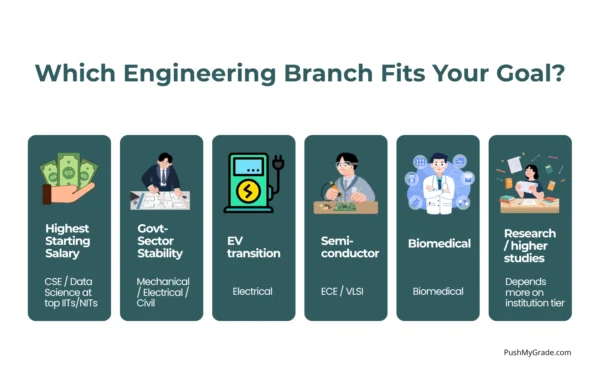
Which Engineering Branch Is Best For The Future?
There is not one answer to this question. Every article on this topic answers “CSE” and stops there. The real answer depends on what you are optimising for.
Highest starting salary from campus:
CSE or Data Science at a top IIT or NIT. Median salaries are 2–3× higher than core branches at the same institution. During the 2024–25 placement season at IIT Madras, CSE reported a median salary of ₹37.5 LPA, while Civil Engineering reported a median salary of ₹ 17.5 LPA.
Government sector stability:
Mechanical, Electrical, or Civil Engineering can provide access to PSU jobs through GATE at NTPC, BHEL, ONGC, and Power Grid, with starting pay of around ₹8–14 LPA, along with job security and allowances. The risk profile is fundamentally different from private-sector hiring.
Specific industry tailwinds over the next decade:
Electrical Engineering is well positioned for the EV transition. Engineering branches such as ECE and VLSI benefit from India’s semiconductor push. Biomedical Engineering is positioned for growth in healthcare technology. These are not just short-term trends; they are tied to capital already committed.
Research or higher studies abroad:
The branch matters less than the IIT/NIT tier. A well-ranked institution in Civil or Mechanical supports graduate school admissions through faculty connections and research opportunities that private colleges don’t provide.
The worst way to answer this question is to follow what is trending on LinkedIn. AI engineering is trending, but students most likely to benefit from the AI wave have strong CS, mathematics, or ECE fundamentals. Instead of choosing a B.Tech programme simply because it is titled “Artificial Intelligence Engineering,” check whether the programme has an established placement record. A programme launched only two years ago with borrowed faculty and no verified placement data carries additional risk.
The Branch-or-College Decision: Which Matters More?
Most students face a difficult choice between the two. Let’s be direct.
At the IIT tier, take any seat. Even Civil Engineering at IIT Roorkee offers a degree backed by alumni networks, GATE preparation support, research opportunities and faculty connections that no private-college CSE programme can easily match. The overall floor is high. Students placed from Civil at top IITs have averaged salaries well above the median offered by many private-college CSE programmes.
Below the IIT tier, branch matters more than college name. CSE or ECE at a solid NIT—such as NIT Trichy, NSIT, DAIICT or NIT Warangal—generally outperforms core branches at mid-tier private colleges in placement rate, median salary and job profile quality. The data has remained consistent across years.
Exceptions apply if you already have a specific plan that does not depend on campus placements—going abroad for an MS? The IIT tag helps regardless of branch. Preparing for GATE? Your GATE score matters more than campus placement. Planning to attempt UPSC ESE? Civil or Mechanical from any decent institution can qualify you.
Most students don’t have a plan that specific at 18. So the practical rule is simple: at the IIT level, take any seat. Below IIT, prioritise CSE or ECE over core branches unless you have a clear alternative route.
Two Branches Worth Looking at Harder
Electrical Engineering:
Students often skip Electrical Engineering because of its syllabus. That can work in your favour: EE has lower cutoffs at many NITs, so students with a slightly lower JEE rank can get into a better NIT by choosing EE over CSE. Placement outcomes for EE at IITs are also nearly identical to ECE. And the demand created by India’s EV transition is structural, not just hype.
Energy Engineering:
IIT Delhi launched its BTech in Energy Engineering programme in 2021. This is another branch worth watching. Its intake is small now, but the programme could become significantly more relevant by 2030, particularly as India’s renewable energy capacity moves beyond the 500 GW target. The job-market infrastructure is not yet fully developed for fresh graduates from non-IIT colleges, but IIT-level Energy Engineering graduates are already moving into strong positions.
Hidden Truth You Should Know
Nobody predicted in 2010 that mobile app development would define the job market by 2015. Similarly, few anticipated the scale of cloud computing’s dominance in 2015. Any prediction about which engineering branch will lead by 2035 comes with genuine uncertainty.
What remains consistent through every industry shift is this: strong fundamentals transfer. A Mechanical engineer with a deep understanding of dynamics can move into robotics and learn to code. An Electrical engineer who genuinely understands signal processing can work on communication systems for autonomous vehicles. Students who struggle are the ones who have learned enough to pass exams, but not enough to think through problems they’ve never seen before.
Choose a branch you can genuinely study for four years without losing interest. Then build market-relevant skills on top of that foundation. This combination has remained valuable through every major industry shift of the past 30 years, and it is likely to remain valuable through the next one.
Data sources: NIRF 2025 placement reports, IIT Roorkee official placement statistics 2025, IIT Delhi branch-wise package data 2025–26, IIT Civil Engineering placements, IIT Madras NIRF 2025 submission.