

Computer Science and Engineering is the most chosen and popular engineering branch in India. Every year, a huge percentage of JEE aspirants choose CSE as their first preference.
Students chase it for the salary numbers they’ve seen on LinkedIn. Parents push it because it sounds future-proof. Counsellors recommend it because it’s easier to place students in CSE. But these should not be the reasons to choose a branch.
Before considering CSE as your future option, you should know which subjects you will study, what those subjects will really teach you, which ones you may forget after the exam, and why a CSE graduate from IIT Kanpur and one from a mid-tier private college can face completely different employment realities despite having the same degree title.
This article covers the important aspects of BTech Computer Science and Engineering and helps you make a more informed decision about your future.
What BTech CSE Really Teaches You (Beyond the Brochure)
BTech Computer Science and Engineering is a 4-year, 8-semester undergraduate engineering degree. It covers the design, development and management of software systems, computing algorithms, and the hardware-software interface that makes modern computing possible.
Students sometimes misread the name. “Computer Science” and “Engineering” are two different but connected areas of study in one programme. CSE is a single combined academic branch that combines both.
Computer Science largely concerns the foundations of computation: what can be computed, how efficiently it can be computed, and what constraints apply. Subjects such as Theory of Computation, Algorithms, Discrete Mathematics, and Compiler Design fall on this side of the curriculum. It’s not just about writing apps; it teaches you the mathematical and theoretical principles of computation.
Engineering is the practical application of knowledge used to design and build real-world systems. Software Engineering, Operating Systems, Computer Networks and Database Management Systems belong here. These subjects teach you to build systems that can work reliably, scale under load and communicate with other systems.
A BTech CSE curriculum combines both. This is what makes the degree genuinely useful. Mathematics and theory sharpen your reasoning, while engineering subjects teach you to build real systems. A CSE graduate who takes both sides seriously can do what a bootcamp or self-taught programmer often can’t because they understand the foundations beneath the frameworks.
The main problem with the degree is how it delivers the curriculum. Many mid-tier college curricula teach the theory without clearly showing its relevance and teach engineering subjects without enough exposure to live projects, version control, or deployment. A student may graduate knowing what a Turing machine is but still struggle to build a REST API.
This is not simply an old course-design problem. The 2025 Aspiring Minds employability report cited in this article found that industry standards assessed 45% of engineering graduates as unemployable. The degree has always worked. The delivery has been inconsistent.
4-Year BTech CSE Roadmap
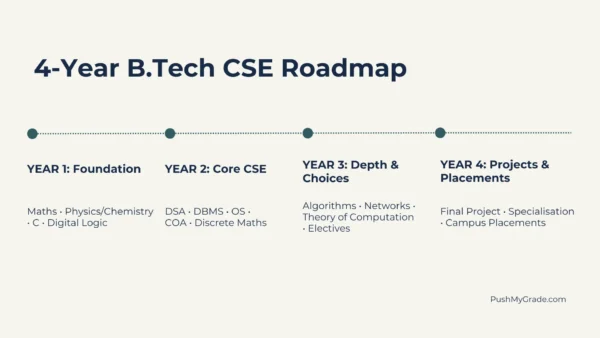
Year One: The Foundation
You don’t learn the main CSE in the first year of a BTech CSE programme. Here, you mainly learn Engineering Maths (Calculus, Linear Algebra, Probability), Physics or Chemistry, an introduction to C programming, Digital Logic Design, and general engineering subjects like Engineering Drawing.
This can surprise students who expect to walk straight into app development. But first-year subjects have a clear purpose: they build the mathematical and technical foundation you will need later. Calculus and Linear Algebra will resurface in Machine Learning. Probability will appear throughout Statistics and Algorithms. Digital Logic provides the foundation for Computer Architecture.
Most students treat Year 1 as a survival exercise. Students who treat it as a foundation build a stronger base by Year 3.
Programming in C is your first serious introduction to how a computer actually executes instructions. Don’t learn it only to pass the exam. Learn it to understand memory, pointers, and how a program communicates with the system. That knowledge becomes valuable later and helps distinguish an engineer who understands how systems work from someone who only knows how to use higher-level tools.
Year Two: Where Real Computer Science Begins
The main CSE curriculum takes shape in Semesters 3 and 4.
Data Structures and Algorithms (DSA) is one of the most important subjects in the entire four-year programme, not because of the theory, but because it is a major part of technical hiring processes at many leading technology companies. Google, Microsoft, Amazon, Goldman Sachs, Jane Street, Adobe, and many others assess candidates on their understanding of DSA. If you learn one subject deeply enough to solve problems confidently, make it this one.
Discrete Mathematics appears in Semester 3 and can feel abstract at first. But it isn’t. Graph theory, combinatorics, and set theory provide the mathematical foundation behind databases, networks, cryptography, and algorithms. Students who overlook these concepts often struggle with them later in Graph Algorithms, Compiler Design, and System Design.
Database Management Systems (DBMS) teaches you to think about information in a structured way. SQL is a practical skill, but relational database design is a way of thinking. Both of them become useful in backend development, data science, and business intelligence roles.
Operating Systems (OS) teaches you how a computer manages its resources: how processes run in parallel without interfering with each other, how memory is allocated and freed, and how input and output are handled. OS provides a foundation for technical interviews and is particularly relevant to backend engineering and DevOps. It’s a harder subject than it looks in the syllabus.
Computer Organisation and Architecture (COA) shows you how the CPU actually executes your code. This is where the hardware-software connection becomes concrete. COA matters more if you’re going into embedded systems, chip design, or system-level programming. It is also an important and high-scoring core subject for the GATE examination.
Year Three: Depth and the First Real Choices
Your CSE curriculum becomes more demanding and interesting in Year 3. You get more opportunities to explore your interests.
Design and Analysis of Algorithms is an advanced version of DSA. You learn how algorithms work and how to prove their correctness, measure their efficiency, and choose between competing approaches to a given problem. This subject develops the ability not only to solve problems, but also to explain why a particular solution works.
Computer Networks focuses on TCP/IP, routing protocols, the OSI model, and network security. This provides essential infrastructure knowledge in cloud computing, distributed systems, and cybersecurity. All of these require you to understand how data moves between machines.
Theory of Computation (Automata) is the most theoretical subject in the degree. It covers finite automata, Turing machines, formal languages, and computational complexity. These concepts build an important mathematical foundation for Computer Science. It is also a high-weight core subject in GATE. This subject develops your understanding of the limits and possibilities of computation.
Compiler Design shows you what happens when human-written code is transformed into something a machine can execute. It covers lexical analysis, parsing, semantic analysis, and code generation. This gives you a deeper understanding of programming language design, virtual machines, and why interpreted languages behave differently from compiled ones.
Electives show up in Semesters 5 and 6. This is where you can start building a more specific path within CSE. You can choose subjects such as Machine Learning, Cloud Computing, Cybersecurity, Natural Language Processing, Web Development, or Computer Vision. The quality and range of these electives vary significantly between institutions. At IITs and NITs, they generally focus on current research and newer developments. At some mid-tier private colleges, the content may be less current and sometimes relies on older textbook material.
Year Four: The Project and the Test of Reality
Final-year projects can be either the most valuable or the most wasted part of your degree. At IITs and IIITs, some projects are connected to faculty research, startup founders, or real industry problems. At many other colleges, the standard final-year project is a minor academic exercise that has little resemblance to a real production environment.
If your college gives you genuine freedom to choose your project, use it to build something real and deployable. A project deployed on a server that other people can access is far more valuable than one that exists only on your local machine for a demonstration.
Campus placements begin in Semester 7. At top IITs and NITs, Phase 1 placements take place in December, with most seats filling in the first 2-3 days. At mid-tier colleges, the placement process lasts longer because fewer companies participate and fewer opportunities are available.
The 5 Important Subjects for Your Career
A BTech CSE degree covers roughly 40-50 subjects over 8 semesters. Not all of them carry equal weight in interviews or the GATE examination.
Data Structures and Algorithms (DSA):
This is one of the most important subjects for technical interviews. It includes arrays, linked lists, trees, graphs, dynamic programming, and greedy algorithms. Amazon, Google, and Microsoft often recruit students with good DSA skills. You can improve your DSA skills by practising problems on platforms such as LeetCode and Codeforces alongside your regular coursework. This subject is non-negotiable.
Operating Systems:
Key topics include process scheduling, memory management, deadlocks, and file systems. OS comes up in system design interviews and is particularly relevant to backend engineering and DevOps roles. Interviewers ask OS questions to test whether you understand what happens behind the code you write.
Database Management Systems (DBMS):
SQL queries, normalisation, indexing, and transactions are the core of this subject. DBMS is relevant in most technical interviews because most applications interact with databases. SQL proficiency is a baseline expectation, not a differentiator.
Computer Networks:
TCP vs. UDP, DNS, HTTP/HTTPS, load balancing, and firewalls are key topics. Network knowledge is important for cloud computing, backend development, and security. As software systems increasingly rely on distributed infrastructure, understanding how data moves between machines becomes even more valuable.
Object-Oriented Programming with a Modern Language:
This goes beyond theory. You need to write working software in Python, Java, or C++ and discuss concepts such as design patterns, inheritance, and abstraction in the context of systems you’ve built.
All five subjects are also significant for GATE. Theory of Computation, Compiler Design, and Computer Architecture are other important subjects for GATE and research-oriented roles. If your goal is GATE, these subjects should move higher on your priority list.
Read More: Engineering Branches: A Deailed Guide
The Real Placement Statistics
For a fair comparison, look at average and median packages rather than the highest packages. The highest figure often represents only a small number of students and is frequently highlighted in college brochures for promotional purposes.
The difference between a CSE graduate from IIT Madras and one from a tier-3 private college isn’t just the salary. It also includes the type of work, growth opportunities, and the hiring pipeline available to them.
The average package of the 2025 CSE graduation batch at IIT Madras was ₹53.2 LPA. IIT Kanpur’s average package was ₹42.89 LPA. These figures reflect students hired into highly competitive quantitative and engineering roles at companies such as Jane Street, DE Shaw, Google, and Uber.
IIIT Hyderabad’s CSE batch averaged ₹32.8 LPA in 2025. NIT Trichy CSE reported an average of ₹17–24 LPA, with placement rates of 98–100%. BITS Pilani averaged ₹21.4 LPA in 2024. At tier-2 private colleges such as VIT, SRM, Manipal, and KIIT, the median CSE package is around ₹4–7 LPA.
At tier-3 state engineering colleges, the median is around ₹2.5–3.5 LPA, and this figure applies to placed students. The percentage of students who secure directly relevant roles is lower.
This gap isn’t about intelligence or effort. It’s the hiring pipeline. Product companies don’t visit most private colleges because they can meet much of their demand through the volume of pre-screened candidates available from IITs, NITs, and a handful of top deemed universities. Mass recruiters, including IT services companies, visit a wider range of colleges, but typically hire for execution-focused roles at fixed salary levels.
The gap is real, but it can narrow with time. Two to three years after graduation, skills, certifications, and professional performance become bigger drivers of salary than the college name. But the starting point still matters. A ₹4.5 LPA starting salary and a ₹22 LPA starting salary compound very differently over the first five years of a career.
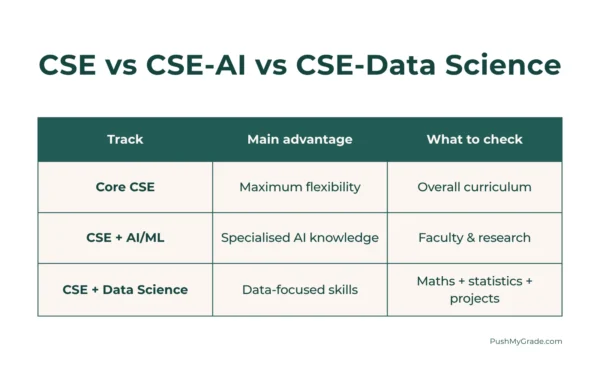
CSE core vs CSE-AI vs CSE-Data Science
This is one of the most common questions in counselling discussions. The answer is simple.
Choose core BTech CSE if you want maximum flexibility. Core CSE is generally eligible for all technical hiring drives that any specialised variant is eligible for. It also makes you eligible for the roles that require “CSE or equivalent.” At mid-tier and lower-tier colleges, this broader eligibility can keep more campus placement opportunities open.
At IITs and top NITs, the CSE elective system can give core CSE students more flexibility. You can take electives like AI/ML, Natural Language Processing, and Deep Learning to build specialised knowledge while maintaining a broader core CSE foundation.
A BTech CSE with an AI/ML specialisation makes sense at institutions with genuinely strong, research-connected faculty in this area, such as IIT Bombay, IIT Delhi, IIIT Hyderabad, IIT Madras, and a handful of others. The curriculum at these institutions stays current because faculty members actively publish in these fields. Treat with scepticism any college that introduced an AI specialisation recently because of AI’s growing popularity. Check the faculty’s research credentials before choosing the specialisation.
BTech CSE with Data Science follows a similar principle. If the program focuses mainly on a Python course and a Tableau certification, it isn’t a meaningful specialisation. It’s a marketing label. A stronger program should include subjects such as statistics, linear algebra, distributed computing, and a substantial project using real-world data.
The principle is simple: Consider faculty quality and research depth at the same institution before choosing between tracks. Across different institutions, choose the better institution before worrying about the track.
Four Paths after BTech Computer Science and Engineering
Direct Placement:
This is the default path for most students. Campus placements take place in the final year. Companies range from product companies (Google, Microsoft, Adobe, proprietary trading firms) to IT services (TCS, Infosys, Wipro, Cognizant) and startups. Your college tier determines which companies visit your campus. Your DSA skills and project portfolio influence your chances of securing an offer.
GATE and M.Tech:
GATE is a competitive national examination for government jobs, post-graduate admission and financial scholarships. Questions come from the CSE syllabus. Important topics include Algorithms, Operating Systems, Computer Networks, DBMS, Theory of Computation, Computer Organisation and Architecture, Discrete Mathematics, and related subjects.
A high GATE score can open opportunities for M.Tech programs at IITs, research programs, and recruitment in PSUs (ISRO, DRDO, and NTPC) for relevant software roles. Students with limited campus opportunities can also use GATE to access a stronger postgraduate institution, which can change their subsequent hiring opportunities.
MS abroad:
Many top-ranked IIT and NIT CSE graduates pursue Master’s degrees in the US, Canada, or Germany. Carnegie Mellon, MIT, Stanford, the University of Toronto, TU Munich and other universities consider factors such as GRE scores, GPA, research experience, and statements of purpose, depending on the program and institution. An IIT CSE research background can strengthen an application. A student from a mid-tier college can also secure admission, but GRE performance and research output matter more.
Startups or building your own:
CSE graduates with strong foundations and few deployable projects can join early-stage startups or start their own. The risk is higher, the learning is faster, and career advancement is less constrained by a traditional career path. This route makes more sense when your technical skills are strong and the financial risk is manageable.
Read More: Top Private Engineering Colleges in India 2026: Ranking, Fees, Placements, Admission
What Actually Gives a CSE Student an Edge?
Here are a few things that can help you stand out from the other students. Build these habits alongside your regular academic coursework.
Start building before placements start:
A student who writes their first line of code outside class in Semester 5 is already several years behind someone who started in Semester 1. Students with strong placement outcomes usually have built personal projects, contributed to open source, or won at least one hackathon well before placement season. Their portfolio reflects sustained work, not something assembled three months before applying for jobs.
Treat DSA as a dedicated skill, not a subject:
The algorithms you learn in class are a starting point. Serious preparation involves 4–6 months of consistent daily practice on competitive programming platforms such as LeetCode, Codeforces, and GeeksforGeeks. Product company interviews often test your ability to solve algorithmic problems under time pressure. Students who practise regularly in these conditions are better prepared for this interview format.
Understand what the industry actually uses:
The curriculum teaches C, Java, and theoretical frameworks. The industry also uses Python, JavaScript, TypeScript, Go, and increasingly, cloud infrastructure. Students who bridge this gap during college through internships, self-study, or open-source work can contribute from day one. Others may spend their first year on the job learning technologies and practices they could have explored earlier.
The uncomfortable truth is that the most important learning in BTech CSE often happens outside the classroom. The classroom gives you the foundation. What you build with that foundation, and how quickly you apply it to real problems, shapes your actual career outcome.
One Number That Should Recalibrate Everything
IIT Bombay placed 70% of participating students in 2025. Not 100%. Seventy per cent.
IIT Bombay is one of India’s leading engineering institutions. Yet even at this level, placement is not guaranteed for some students who enter the process.
This isn’t a criticism of IIT Bombay. It reflects a realistic job market where even the best students at the top institutions don’t guarantee a placement. Students who didn’t secure campus placements moved toward GATE preparation, MS applications, startup roles, or self-employment. The degree gave them a foundation for all of those paths.
But if even a leading institution doesn’t secure a campus placement, the claim “CSE guarantees a great job” should be viewed carefully at institutions below that level.
Choose BTech CSE because you’re interested in computing. Spend the four years building real things. Treat DSA as seriously as any exam. Choose your college based on its placement record for your specific branch. And enter with the understanding that a degree is a foundation, not a guarantee. What you build on that foundation is your responsibility.
Data references: IIT Madras NIRF 2025 placement submission; IIT Kanpur placement statistics 2024-25; IIT Bombay placement report 2025; IIIT Hyderabad annual placement report 2025; Aspiring Minds National Employability Report; WEF Future of Jobs Report 2025; BITS Pilani placement statistics 2024; NIT Trichy annual placement data 2023-24.