

Civil engineering offers several government career paths in India, but they are not all the same. Each route has its own exam, eligibility rules, pay structure, and posting pattern. That makes choosing the right government job more complicated. This guide breaks down the major civil engineering govt jobs in India, including pay levels, eligibility, career paths, and likely postings.
Which Civil Engineering Govt Job Route Fits You?
| If you are… | Prepare for | Why |
|---|---|---|
| A final-year B.Tech student strong in structures | GATE + ESE | The two exams have largely overlapping preparation. |
| A B.Tech student targeting a high starting salary | GATE-based PSUs | NHAI starts at Level 10, and the larger PSUs pay on E-grade scales. |
| A diploma holder with no work experience | RRB JE + your home-state board | Railway JE recruitment doesn’t require prior experience; some SSC JE posts do. |
| Someone who missed this year’s SSC JE and RRB JE windows | Prepare for the next year + apply to state boards in the meantime | Keep preparing for next year’s exams and watch for upcoming notifications. |
| Age 31 or older | RRB JE + state boards | For the general category, the upper age limit is 33 for RRB JE and 30 for ESE. SSC JE allows 30 or 32, depending on the post. |
| Tied to your home state | Your state board | Domicile rules, local-language requirements and the state’s own pay structure may apply. |
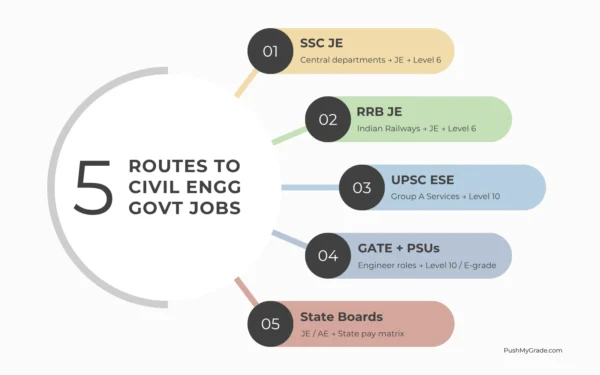
5 Routes to Civil Engineering Govt Jobs
These are the five main routes to civil engineering government jobs. Choose the route that matches your eligibility and career goals.
| Route | Main employers | Who can apply | Starting point |
|---|---|---|---|
| SSC JE | CPWD, MES, Central Water Commission, BRO and other central bodies | Degree or diploma; some posts require 2 years of experience | Junior Engineer, Level 6 |
| RRB JE | Indian Railways | 3-year diploma or degree | Junior Engineer, Level 6 |
| UPSC ESE | Group A engineering services | Engineering degree; generally age 21–30 | Assistant Executive Engineer level, Level 10 |
| GATE + PSU | NHAI, NPCIL, AAI, PGCIL and others | Engineering degree and a valid GATE score | Level 10 at NHAI; E-grade scales elsewhere |
| State boards | PWD, irrigation, public health, rural works, urban bodies | Diploma or degree, depending on the post; often domicile rules apply | State pay matrix |
Route 1: SSC JE
SSC JE is one of the main routes into Junior Engineer jobs in central government departments. It recruits civil engineers for CPWD, MES, the Central Water Commission and BRO. SSC separately publishes the branch-wise vacancies.
Pay and eligibility
SSC JE posts fall under Level 6, with basic pay ranging from ₹35,400 to ₹1,12,400.
A civil engineering degree qualifies you for the post. A 3-year diploma also qualifies you, although some departments require 2 years of relevant experience. The exact requirement depends on the post, so check the post-wise eligibility table in the notification.
The upper age limit is 30 or 32, depending on the post. SC/ST candidates get 5 years of relaxation, and OBC candidates get 3 years.
The selection process
The exam has two computer-based papers:
| Stages | Details |
|---|---|
| Paper I | 200 questions, 200 marks, 2 hours. It is qualifying only. |
| Paper II | 100 questions, 300 marks, 2 hours. It determines your rank. |
Both papers have negative marking: 0.25 marks for a wrong answer in Paper I and 1 mark in Paper II. The minimum qualifying marks are 30% for General, 25% for OBC/EWS, and 20% for other categories. Paper II uses +3 marks for a correct answer and −1 for a wrong answer.
SSC does not guarantee home-state posting. It doesn’t publish state-wise vacancy lists, so you cannot choose a city yourself.
Route 2: RRB JE
RRB JE is the main route into Junior Engineer jobs in Indian Railways. Civil engineers work on construction, maintenance, and inspection of tracks, bridges, and station buildings.
Pay and eligibility
RRB JE posts are at Level 6, with a basic pay of ₹35,400.
For civil posts, you need a 3-year Diploma or a bachelor’s degree in civil engineering from a recognised university or institution.
The general category age limit is 18 to 33 years. Reserved categories, including SC, ST, OBC, and PwD, get the applicable upper-age relaxations.
The selection process
Selection has four stages:
CBT 1 → CBT 2 → Document Verification → Medical Examination
| Stages | Details |
|---|---|
| CBT 1 | 100 questions, 100 marks, 90 minutes. It is qualifying only. |
| CBT 2 | 150 questions, 150 marks, 2 hours. It determines your rank. |
| Document Verification | Candidates are shortlisted based on their CBT 2 scores. |
| Medical Examination | Railway Medical Authorities conduct a post-specific fitness test. Civil Engineering posts fall under medical standards such as A-3, B-1, B-2, or C-1. |
Both papers have negative marking: 1 mark for each correct answer and 1/3 mark deducted for each wrong answer. The minimum qualifying marks are 40% for General/EWS, 30% for OBC/SC, and 25% for ST. These qualifying thresholds apply to both CBT 1 and CBT 2.
RRB JE gives zone-wise vacancies for the posts. You must choose your zone before seeing the final cutoffs, so compare the zone-wise vacancy tables in the notification before applying.
Route 3: UPSC ESE
UPSC ESE is the main route into Group A civil engineering govt jobs. It recruits civil engineers for services such as the Central Engineering Service, Central Engineering Service (Roads), Border Roads Engineering Service, Central Water Engineering Service, Survey of India and Indian Railway Management Service.
Pay and eligibility
UPSC ESE posts are at Level 10, with a basic pay of ₹56,100.
You must hold a Civil Engineering degree from a recognised Indian university/institution. For the general category, the age limit is 21-30 years. The upper age limit is 33 for OBC candidates and 35 for SC/ST candidates.
The selection process
ESE has three stages:
Prelims → Mains → Personality Test
Stage I: Preliminary Examination (Objective Type)
| Papers | Details |
|---|---|
| Paper 1 (General Studies & Engineering Aptitude) | 200 marks, 2 hours |
| Paper 2 (Civil Engineering) | 300 marks, 3 hours |
Stage 1 carries 500 marks. Both papers are MCQ-based, with 1/3 negative marking for each wrong answer. This stage shortlists candidates for Stage II.
Stage II: Main Examination (Descriptive Type)
| Papers | Details |
|---|---|
| Paper 1 (Civil Engineering) | 300 marks, 3 hours |
| Paper 2 (Civil Engineering) | 300 marks, 3 hours |
Stage II carries 600 marks. Both papers are descriptive. You need to qualify at this stage to be called for the interview.
Stage III: Personality Test / Interview
Stage III carries 200 marks. It tests your leadership, communication, intellectual integrity, and overall suitability for a public service career.
The final merit list is based on marks from Stage II and Stage III.
Route 4: GATE and the PSUs
GATE is a major route into civil engineering government jobs at PSUs, including organisations that use E-grade pay scales.
Exam and recruitment
You are eligible for the GATE exam if you are currently studying in the third year or higher of any undergraduate degree or if you have already graduated. There is no age limit, no restriction on the number of attempts and no minimum percentage or CGPA required.
| Exam | Details |
|---|---|
| GATE | 65 questions, 100 marks, 3 hours. |
Negative marking applies only to multiple-choice questions. A wrong answer in a 1-Mark MCQ carries a 1/3-mark deduction, while a wrong answer in a 2-mark MCQ carries a 2/3-mark deduction.
After the GATE results, each PSU releases its own recruitment notice and sets its own eligibility and selection rules. Your GATE score is the entry point, not a guarantee of recruitment.
NHAI recruits civil engineers for Deputy Manager (Technical) posts at Level 10, with a basic pay of ₹56,100 to ₹1,77,500. Selection was based on the GATE score and NHAI’s own eligibility criteria.
NPCIL, PGCIL, NHPC, AAI (Junior Executive, Civil) and Coal India have also used GATE scores for civil engineering recruitment in recent cycles. Each organisation decides which GATE score year it accepts.
GATE score validity and pay
GATE scores are valid for 3 years. However, a PSU can specify which score year it accepts. Treat the three-year validity as the maximum period, not a guarantee that every PSU will accept an older score.
Large PSUs generally use E-grade pay scales. For example, E1 can range from about ₹40,000 to ₹1,40,000, and E2 can range from about ₹60,000 to ₹1,80,000. Quoted CTCs for civil trainee roles can range from about ₹12 lakh to ₹22 lakh a year. These are broad benchmarks; always check the actual PSU notification for the current figures.
A second use for your GATE score
The same GATE score can also open M.Tech seats at IITs and NITs. This gives you another option if you do not find a PSU recruitment notice that fits your profile.
Read More: Top MBA Colleges in India
Route 5: State Boards
State recruitment boards account for a large share of civil engineering government jobs, and each state follows its own recruitment cycle. Public service commissions generally recruit for Assistant Engineer posts, and subordinate or technical selection boards recruit Junior Engineer and Sub Engineer candidates.
Each state follows its own pay matrix. Vacancies are usually large, and competition is often lower than in central government examinations. Pension rules also vary by state. A few states have returned to the old pension scheme. Check your state’s recruitment notification for the exact vacancies, eligibility requirements, and pay scales.
State recruitment calendars don’t always follow the central recruitment cycle. That can work in your favour if you track three or four states and apply whenever a suitable vacancy opens.
Other Civil Engineering Govt Jobs Recruitment Routes
These are some other recruitment routes for government jobs outside the five main recruitment routes.
| Route | Organisations / Bodies | Typical opportunities |
|---|---|---|
| PSUs – Direct Recruitment | RITES, MECON, NLCIL, Engineers India Limited (EIL), BEL, BHEL | Engineers, Junior Engineers, technical staff, project and probationary engineers |
| Metro & Infrastructure Corporations | GMRC, NCRTC, DFCCIL | Civil engineers, managers, supervisors, surveyors and technical staff |
| Central Research & Autonomous Institutes | IISERs, IITs, AIIMS, IIITs, Central Universities | Junior Engineers, Executive Engineers, technical officers and site/infrastructure staff |
| Defence & Scientific Organisations | BARC, DRDO laboratories | Scientific officers, scientific assistants, apprentices and project-linked technical roles |
| Deputation & Statutory Bodies | India Post (Civil Wing), NHIDCL | Assistant Engineers, associates and technical consultants |
These organisations conduct their own recruitment. Eligibility, selection process and vacancies vary by organisation, so check the official recruitment notification before applying.
How the Salary Actually Adds Up
Basic pay is only the starting point. Your monthly salary also includes Dearness Allowance (DA), House Rent Allowance (HRA) and Transport Allowance. The final amount depends on your pay level, place of posting and applicable deductions.
The figures are estimates based on the current allowance rates.
| Monthly figure | JE, X-class city | JE, Z-class town | Level 10 officer, X-class city |
|---|---|---|---|
| Basic pay | ₹35,400 | ₹35,400 | ₹56,100 |
| DA at 60% | ₹21,240 | ₹21,240 | ₹33,660 |
| HRA | ₹10,620 | ₹3,540 | ₹16,830 |
| Transport allowance with DA | ₹5,760 | ₹2,880 | ₹11,520 |
| Gross salary | ₹73,020 | ₹63,060 | ₹1,18,110 |
| Pension contribution (10% of basic + DA) | ₹5,664 | ₹5,664 | ₹8,976 |
| Gross after pension contribution | ₹67,356 | ₹57,396 | ₹1,09,134 |
The table shows how a JE with a ₹35,400 basic salary can earn a much higher gross salary with allowances, though the final amount depends on the posting and applicable deductions.
Income tax and other deductions, such as health-scheme contributions, may further reduce your take-home pay. Pension rules depend on the employer and appointment date. Treat the figures above as an estimate, not a guaranteed in-hand salary.
How to Read a Recruitment Notice Carefully
A recruitment notice includes several details that can determine your eligibility. These are the six lines worth checking before you apply.
| Line | Why it matters |
|---|---|
| Age cut-off date | The notice specifies the date used to calculate your age. Different exams may use different cut-off dates. |
| Post-wise qualification | Eligibility can vary by post, even within the same examination. Some positions require additional qualifications or experience. |
| Zone or state choice | Some recruitment restricts the number of zones, states, or boards you can choose. Your choice may affect where you can be considered for a post. |
| Physical or medical standard | Certain posts include physical, medical or other fitness requirements in addition to the written exam. |
| Domicile and language | State-level recruitments may have domicile, local-language or other regional requirements. Check these before applying. |
| Correction window | The correction period gives you a limited opportunity to fix mistakes in your application. Check the dates carefully. |
How to Prepare For the Exams
Preparing for civil engineering govt jobs becomes easier when you build one strong technical base and adapt it to each exam’s pattern. Some core subjects overlap, but the depth and question style vary.
Build the common technical foundation
Structures, geotechnical engineering, water resources, environmental engineering, transportation, and surveying form the core of preparation for major civil engineering exams. Build a strong foundation in these subjects first.
Know what each exam adds
Junior-engineer exams such as SSC JE, RRB JE, and state boards place more emphasis on their specific technical syllabus and exam pattern. GATE requires stronger conceptual understanding and also includes mathematics and aptitude. ESE adds a descriptive component later in the process.
Start with previous-year papers
Previous-year questions show you what an exam actually asks, not just what appears in the syllabus. Solve them regularly to identify recurring topics and question styles. They also help you to find areas that need more revision.
Practise with timed mocks
Once you have a solid grasp of the basics, start practising full-length mock tests under exam conditions. Focus not only on your score, but also on time management, choosing questions wisely, and avoiding negative marking.
Keep an error log
Don’t just check your mock score and move on. Record the questions you got wrong and write down what you missed—a concept, formula, calculation, or question-reading mistake. Review this list regularly to identify your weakest areas.
Adapt your preparation to the target exam
You don’t need five completely separate preparation plans. Build a common technical base first, then tailor your practice to the target exam. Spend more time on the high-scoring subjects, question types, and sections.
Frequently Asked Questions
What are the best civil engineering govt jobs after B.Tech?
At the starting level, ESE (Level 10, Group A) and GATE-based PSU jobs such as NHAI (Level 10) are among the strongest options. In terms of vacancies, Railway JE recruitment can offer many more civil posts. The most suitable route depends on your qualifications, exam preparation, and career goals.
Which civil engineering govt jobs can a diploma holder get?
Diploma holders can apply for Junior Engineer posts through SSC JE, RRB JE and many state-level recruitment boards. Some SSC JE posts require relevant experience. A 3-year diploma is sufficient for RRB JE posts. ESE- and GATE-based PSU jobs need a degree.
Is GATE compulsory for civil engineering govt jobs?
No. SSC JE, RRB JE, ESE, and state-level recruitment exams do not require GATE. Some PSU jobs, including NHAI, NPCIL, PGCIL, and NHPC, use GATE scores in the selection process.
Can I get civil engineering govt jobs without an exam?
Permanent government recruitment involves a written examination or another formal selection process, and some PSU positions use GATE scores. Some government institutions or project bodies may recruit candidates directly for contract roles, but these positions generally do not offer the same benefits as permanent posts.
What is the age limit for civil engineering govt jobs?
It depends on the exam. SSC JE allows up to 30 or 32, RRB JE allows 18 to 33, and ESE allows 21 to 30 for General candidates. Reserved categories, including SC, ST, OBC, and PwD, get the applicable upper-age relaxations.
What is a central government Junior Engineer’s salary?
Central government Junior Engineer posts are generally at Level 6, with a basic pay of ₹35,400. With DA, HRA, and transport allowance, gross pay is around ₹63,000 to ₹73,000 a month, before pension contributions and tax.
Data Note and Official Sources
We source recruitment rules, eligibility criteria, pay levels, and examination details from the official government websites. These details can change from one recruitment cycle to the next. Always verify the latest notification on the recruiting authority’s official website before applying.
Key official sources:
- SSC: ssc.gov.in
- UPSC: upsc.gov.in
- Railway Recruitment Boards: rrbcdg.gov.in and rrbapply.gov.in
- GATE: gate2027.iitm.ac.in
- NHAI: nhai.gov.in