

Kerala’s engineering landscape looks different from states such as Karnataka, Odisha, Delhi, and Rajasthan. The strongest names in this list are largely government or government-aided institutions. Private colleges are less represented at the top. This guide compares top engineering colleges in Kerala using NIRF 2025 rankings, official placement reports, and available fee data. Where we could not verify a ranking or placement figure, we clearly marked it in the respective college section.
Top Engineering Colleges in Kerala At A Glance
10 colleges compared
5 appear in the official NIRF 2025 Engineering rankings; the remaining 5 have no current, verifiable NIRF Engineering rank.
Government-led top tier
Kerala’s strongest colleges in this list are government or government-aided. This differs from other states, where private colleges dominate the list.
4-year fee range
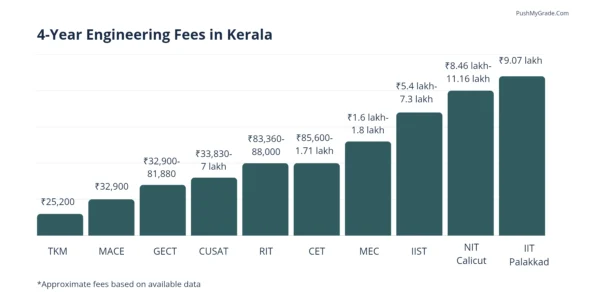
Approximately ₹25,200 to ₹11.96 lakh, one of the widest spreads in this series, largely due to government subsidies.
A notable ranking change
Government Engineering College, Thrissur was ranked in the 201–300 NIRF Engineering band in 2024, but does not appear in the 2025 NIRF ranking.
Best fee-to-outcome ratio
Mar Athanasius College of Engineering charges roughly ₹32,900 for the full course and reports an average package of ₹10 lakh.
Best Engineering Colleges in Kerala: Quick Comparison Table
NIT Calicut
IIST Thiruvananthapuram
IIT Palakkad
College of Engineering, Trivandrum (CET)
GEC Thrissur
CUSAT, Kochi
TKM College of Engineering, Kollam
Mar Athanasius College of Engineering, Kothamangalam
Model Engineering College, Thrikkakara
Rajiv Gandhi Institute of Technology, Kottayam
Note: NIRF publishes exact numeric ranks only up to 100. Below that, colleges are placed in ranking bands without a disclosed order within each band.
Top Engineering Colleges in Kerala: Detailed Review
1. NIT Calicut (National Institute of Technology, Calicut)
NIT Calicut is Kerala’s highest-ranked engineering college. It reports an average package of ₹12.5 lakh. Fee data varies across sources: one lists ₹11.16 lakh for the full 4-year course, while another lists ₹2,11,500 for the first year alone. Since the figures do not align, we don’t publish a single exact fee and instead present the figure as a range. We also couldn’t find a specific, recent highest-package figure that we could reliably use.
2. IIST Thiruvananthapuram (Indian Institute of Space Science and Technology)
IIST Thiruvananthapuram is Asia’s first space university and offers a direct academic pathway into ISRO. More than 1,442 alumni currently work at ISRO. For the 2023–24 batch, 89 of 116 UG students were placed, with a median package of around ₹11.65 lakh. Across different sources, the highest package has been reported at ₹21.5 lakh and ₹28 lakh. The approximate 4-year fee is ₹5.4–7.3 lakh.
3. IIT Palakkad
IIT Palakkad is one of the newer IITs. Reported average packages range from ₹12 lakh to ₹13.93 lakh, depending on the source. We couldn’t find a specific, recent highest-package figure we could reliably use. The 4-year fee is around ₹9.07 lakh.
4. College of Engineering, Trivandrum (CET)
CET is Kerala’s oldest engineering college. It reports an average or median package of ₹5.20–6 lakh, with a highest package of ₹33 lakh. These figures vary across sources. With the government subsidy, the 4-year fee is approximately ₹85,600 to ₹1.71 lakh.
5. Government Engineering College, Thrissur (GECT)
GECT ranked in NIRF Engineering band 201-300 in 2024. However, it doesn’t appear in the published NIRF 2025 Engineering rankings or ranking band. Its reported placement figures vary by source, with an average package of ₹4.2-6.8 lakh and a highest package of ₹32 lakh. The 4-year fee is around ₹32,900 to ₹81,880.
6. CUSAT, Kochi (Cochin University of Science and Technology)
CUSAT is a state university with its own School of Engineering and entrance exam. We could not find its ranking in the NIRF 2025 Engineering ranking. Its placement figure is consistent across multiple sources. It records an average package of ₹5.4 lakh and a highest package of ₹20 lakh. The 4-year fee ranges from approximately ₹33,830 to ₹7 lakh, depending on the programme.
7. TKM College of Engineering (TKMCE), Kollam
TKM College of Engineering is one of Kerala’s oldest engineering colleges. It is a government-aided college with the lowest tuition fees. The full 4-year tuition fee is almost ₹25,200. The reported average package is ₹5.7-6 lakh, and the highest package is ₹19.5 lakh. TKMCE is not listed in the 2025 NIRF Engineering ranking or rank band.
8. Mar Athanasius College of Engineering (MACE), Kothamangalam
MACE is a well-known private aided engineering college. It offers the strongest fee-to-outcome ratio in this list. The 4-year fee is approximately ₹32,900, against an average package of ₹10 lakh. It is not ranked in the NIRF 2025 Engineering Rank or rank band.
9. Model Engineering College (MEC), Thrikkakara, Kochi
MEC provides the most confirmed placement figures among the government-aided colleges on this list. Reported figures show an average package of ₹3.9 lakh and a highest package of ₹52 lakh. The wide gap suggests that some strong placements may be concentrated toward the top. We don’t have a confirmed median package to confirm this gap. It once ranked in the 251-300 Engineering band in NIRF 2021, but it does not appear in the NIRF 2025 ranking.
10. Rajiv Gandhi Institute of Technology (RIT), Kottayam
RIT is a state-government-owned engineering college. The 4-year fee is around ₹83,360 to ₹88,000, depending on the specialisation and source. We’re not publishing placement figures for RIT because we couldn’t find a reliable package or placement rate. If placement figures matter in your decision, confirm the latest figures directly with the institution.
Related Guide
Government and Aided Colleges Cost Far Less Than Central Institutions
TKMCE (₹25,200) has the lowest tuition fees on the list. MACE, GECT and MEC also cost under ₹2 lakh. Two central government institutes, NIT Calicut and IIT Palakkad, have significantly higher fees at ₹8.46–11.16 lakh and ₹9.07 lakh, respectively. IIST falls in between, with fees of approximately ₹5.4–7.3 lakh.
Admission Routes At A Glance
| College | Admission Routes |
|---|---|
| NIT Calicut, IIT Palakkad | JEE Main or JEE Advanced, through JoSAA counselling |
| IIST Thiruvananthapuram | JEE Advanced, through its own separate counselling process |
| CET Trivandrum, GEC Thrissur, TKMCE, MACE, MEC, RIT Kottayam | KEAM (Kerala Engineering Architecture Medical), the state’s own entrance exam |
| CUSAT | CUSAT CAT (its own exam) or KEAM |
KEAM is the primary admission route for Kerala’s government and aided engineering colleges. NITs and IITs use the national JoSAA counselling system for admissions.
Caution Points Students Should Notice
NIRF ranking:
GECT, CUSAT, TKMCE, MACE, MEC and RIT do not have a current NIRF 2025 Engineering rank or rank band.
Placement figures:
Placement numbers are not equally reliable across all colleges. We could verify the figures for some colleges but not for others.
Highest package vs average:
Don’t rely too heavily on the highest package because it may reflect offers received by only a few top students. Compare it with average and median packages where available.
Admission routes:
Check the admission routes for each college carefully. The colleges on the list don’t follow the same admission process. One entrance exam doesn’t make you eligible for every college.
Data differences:
Fee and placement figures can vary by source, programme and year. Where figures did not align, we have shown a range or clearly flagged the uncertainty. For a specific figure, verify it directly with the institutions.
Choosing Between Two Real Options
NIT Calicut or IIT Palakkad?
| Subject | NIT Calicut | IIT Palakkad |
|---|---|---|
| Average package | ₹12–13.93 lakh range | ₹12–13.93 lakh range |
| Consider | Branch strength and an established campus | IIT brand and campus preference |
CET Trivandrum or CUSAT?
| Subject | CET Trivandrum | CUSAT |
|---|---|---|
| NIRF | 101–150 Engineering band | Not listed in NIRF 2025 Engineering ranking |
| Why consider | A confirmed NIRF standing | Own entrance exam and Kochi location |
| Placement | — | ₹5.4 lakh average package and ₹20 lakh highest package |
MACE or TKMCE for value?
| Subject | MACE | TKMCE |
|---|---|---|
| 4-year fee | Approximately ₹32,900 | Approximately ₹25,200 |
| Average package | ₹10 lakh | ₹5.7–6 lakh |
| NIRF | Current rank could not be confirmed | Current rank could not be confirmed |
| Best for | Very low fees with a stronger reported average package | The lowest tuition fee on the list |
Frequently Asked Questions
Is Kerala’s top engineering college scene mostly government-run?
Yes. Based on our research, the top engineering colleges are mostly government-run. They generally have stronger placement figures and reputation than private colleges. This differs from states such as Karnataka, where private colleges are more prominent in the upper tier by reputation.
Why don’t more Kerala colleges on this list have confirmed NIRF ranks?
Several colleges on this list are not listed in NIRF 2025. NIRF rankings are based on factors such as Teaching, Learning, Research Output, and Perception. Some colleges also choose not to participate in the ranking process. However, not having an NIRF ranking does not mean that a college is worse.
What happened to GEC Thrissur’s NIRF ranking?
GEC Thrissur was in the 201–300 Engineering band in NIRF 2024 but does not appear in the 2025 rankings. We could not determine whether it did not participate or did not qualify. So we have flagged the change in the specific college section.
Which college on this list is the most affordable?
TKM College of Engineering, Kollam, is the most affordable college on this list. Its 4-year tuition fee is approximately ₹25,200.
Sources and Methodology
We take NIRF Engineering ranks and bands directly from NIRF India. Placement and fee figures come from each college’s own data where available. We cross-check the figures with trusted independent sources. When sources differed or showed an older figure as current, we flagged the difference in the relevant college section. If you have current and officially sourced figures for any of the gaps highlighted here, we would rather update this page than leave the information incomplete.