


Enter your SGPA and credits semester-wise to calculate your CGPA instantly. This CGPA Calculator automatically applies credit weights, so you don’t have to do the math manually.
CGPA Calculator
Visual Representation
How to Use the CGPA Calculator
1. Add your semesters. Click + Add Semester to add a row for each semester. You can add as many semesters as you need.
2. Enter your SGPA. Copy each semester’s SGPA exactly as shown on your grade card.
3. Enter your credits. Add the total credits for each semester.
4. Calculate your CGPA. In the Result, you’ll see Total Weight, Total Credit and your CGPA.
Keep Your Original Decimal Values
Enter the full SGPA on your grade card with decimals. Rounding SGPA values can change your final CGPA. This matters especially if you are close to an eligibility cutoff.
Which Credits Should You Enter?
Enter the total credits for each semester that your university used to calculate the SGPA. If your grade card doesn’t show the semester total, add all individual credits for the value.
Under the UGC method, a failed course counts with 0 grade points. Non-credit courses graded Satisfactory or Unsatisfactory are excluded.
Check Your Grading Scale
This calculator is designed for a 10-point CGPA scale. If your grade card uses a 4-point or 5-point scale, this calculator will not give you a meaningful result.
Don’t Have Your SGPA Yet?
Use the SGPA Calculator to calculate your semester grade point average from your grades and credits.
Check Your Result
The result section displays your CGPA, Total Weight and Total Credits. The meter shows where your CGPA falls on the 0–10 scale.
How to Calculate CGPA Manually
You can calculate CGPA by multiplying each semester’s SGPA by its total credits. Add these values, and then divide the sum by the total credits across all semesters.
Formula
This credit-weighted method is used in the UGC guidelines for the Choice Based Credit System (CBCS). The guidelines specify expressing the result to two decimal places.
A Worked Example
Consider a student with the following results:
| Semester | SGPA × Credits | Weighted Score |
|---|---|---|
| Semester 1 | 8.8 × 20 credits | 176.0 |
| Semester 2 | 8.6 × 22 credits | 189.2 |
| Semester 3 | 7.4 × 26 credits | 192.4 |
| Semester 4 | 7.2 × 24 credits | 172.8 |
| Total | 92 credits | 730.4 |
CGPA = 730.4 ÷ 92 = 7.94
Why CGPA Is Not a Simple Average
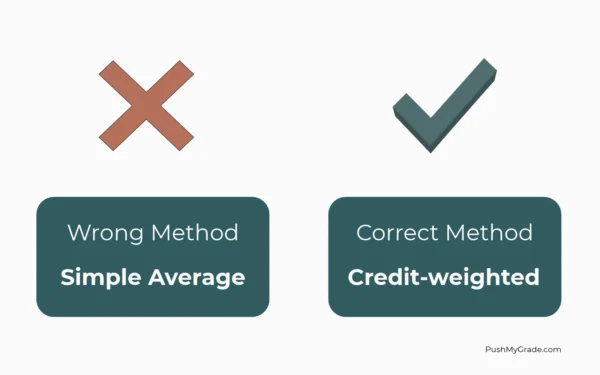
The average of these four SGPA values is 8.00, but the credit-weighted CGPA is 7.94. This difference occurs because each semester carries a different number of credits. A semester with more credits has a greater influence on the final result.
A simple average formula works only when all semesters carry the same number of credits. When credit totals differ, use the credit-weighted method.
Does CGPA Calculation Differ by University?
Yes. Universities can use different rules to calculate CGPA. Some universities have specific rules for grading scales, course credits, failed subjects, grade improvement, and rounding. Here are four key areas where the rules can differ.
Grading Scale
Most Indian universities use a 10-point scale. But some other universities or international institutions use a 4.0-point scale or a letter-grade system with different point weights. Always check the scale on your grade card before calculating your CGPA.
Credit Weighting
Course credits determine how much each subject or semester contributes to your overall CGPA. Different universities use different course credits to calculate CGPA.
Rounding rules
Some universities use rounding rules for the final CGPA or use a particular number of decimal places.
Percentage Conversion Rules
India has no single rule for converting CGPA to a percentage. Each university defines its own official conversion formula. CGPA x10 and CGPA x9.5 are the most common formulas universities use.
How to Increase Your CGPA in the Next Semester
You can improve your CGPA with a clear target and a better study strategy. These six steps can help you use your time better and improve your results in the semester ahead.
Set a Realistic CGPA Target
First, determine what CGPA you want to achieve. Then calculate the SGPA you need for your next semester. If the target is too high to achieve in one semester, plan across the semesters you have left. Our Required SGPA Calculator can help you estimate the score you need.
Prioritise Subjects with More Credits
Not every subject affects your SGPA equally. Higher-credit courses carry more weight than lower-credit courses, so give them enough time in your study plan.
Focus on Grade Boundaries
A small increase in marks can move you into a higher grade band. Check your internal assessment marks, identify subjects where you are close to the next grade boundary, and focus your revision there.
Use Internal Assessments Wisely
Don’t focus only on your final exam score. Assignments, practicals, class tests, and internal assessments also count toward your final grade. Track these marks and avoid losing easy points.
Clear Backlogs as Early as Possible
A failed course can affect your academic record significantly because it counts as zero grade points in the calculation. Clear backlogs as soon as possible and check whether your university replaces the earlier grade after you pass.
Check Your University’s Improvement Rules
If you think your result contains an error or you narrowly miss a grade boundary, check your university’s rules for revaluation, rechecking or grade improvement. Deadlines, fees and eligibility vary, so confirm the procedure before applying.
You cannot improve your CGPA overnight. Consistency matters more than a last-minute push. Small improvements across semesters can make a meaningful difference to your final CGPA.
Frequently Asked Questions
What does CGPA mean?
CGPA stands for Cumulative Grade Point Average. It represents your academic performance across completed semesters, usually on a 10-point scale. This CGPA calculator estimates your cumulative score using your semester SGPA and credits.
Is 3.5 a good CGPA?
It depends on your grading scale. On a 10-point scale, 3.5 is low and generally considered a failing grade or a weak semester result. On a 4.0 scale, 3.5 is generally strong. Check which scale your grade is based on. This CGPA calculator uses a 10-point scale.
Is 9.6 a good CGPA?
Yes. A 9.6 CGPA is an excellent score on a 10-point scale. Under the UGC grading table, 9 and 10 grade points correspond to A+ and O (Outstanding), respectively. It meets the standard eligibility thresholds for placements, higher studies, and scholarship requirements.
Is a 7.6 CGPA considered first class?
It depends on the university’s classification rules. For example, at Anna University, a CGPA of 6.50 and above corresponds to a First Class. At Indrashil University, a CGPA between 6.50 and 7.99 earns a First Class. Under these examples, a CGPA of 7.6 falls within First Class. Check your university’s regulations for the exact threshold.
Is a 9 CGPA easy to achieve?
A 9 CGPA is a strong result on a 10-point scale. Whether it’s difficult depends on your grading system, course structure, and assessment rules. Consistently strong performance across semesters can help you reach this target. Since CGPA is cumulative, a weak semester can affect your overall score for the rest of your degree.
Can I use this calculated CGPA on an official marksheet?
No. A calculator cannot replace or change the CGPA issued by your university. Use the calculated result to estimate your score, plan your academic goals or double-check your calculations. If an application asks for your CGPA before your official result is available, follow the application’s instructions and ask your exam section for the exact steps.