

Chip design, wireless communication, signal processing and embedded systems are the four closely connected areas of Electronics and Communication Engineering. They share the same engineering foundations, but each leads to different kinds of engineering work.
You can see this difference in university syllabuses. A B.E. scheme at a VTU college introduces Verilog in the third semester. Anna University’s curriculum groups electives into specialised areas such as Sensor Technologies, IoT and Signal Processing.
This guide covers what you study in ECE, major career paths, placement reports, and available opportunities after graduation.
What is ECE Engineering?
ECE stands for Electronics and Communication Engineering. It focuses on designing electronic circuits and chips, processing signals, and developing the radio and fibre-optic systems that carry information from one place to another.
In India, ECE and E&TC (Electronics and Telecommunication) are closely related branches. Many universities use these names for similar courses. However, some institutions present them as separate programmes with different syllabuses.
For example, R V College of Engineering in Bengaluru has both ECE and E&TC courses. Its ECE syllabus covers Digital VLSI Design and Digital Signal Processing with ML. Telecommunication Systems and Digital Modulation and Coding are included in the E&TC syllabus. That is why you should compare the syllabi before choosing between the two branches.
The ECE Engineering Syllabus
Semesters 1 and 2 of ECE cover common foundation subjects shared with other engineering branches. These include Engineering Physics, Engineering Chemistry, Engineering Mathematics, Basic Electronics Engineering, Basic Electrical Engineering, Engineering Graphics and Design, and Professional Communication.
The core ECE-specific subjects start in Semester 3. The exact subject names and their semester placement vary by university. The table below follows the 2022 VTU scheme.
| Semester | Syllabus |
|---|---|
| Semester 3 | Mathematics for EC Engineering, Digital System Design using Verilog, Electronic Principles and Circuits, and Network Analysis. |
| Semester 4 | Electromagnetic Theory, Principles of Communication Systems, Control Systems and an option in Microcontrollers. |
| Semester 5 | Digital Signal Processing and Digital Communication. |
| Semester 6 | Embedded System Design, VLSI Design and Testing. |
| Semester 7 | Microwave Engineering and Antennas, and Wireless Communication Systems. |
Anna University’s 2024 curriculum follows a similar progression, with some subjects placed in different semesters. It includes Analogue Communication and Discrete-Time Signal Processing in Semester 4, Digital Communication in Semester 5, Wireless Communication in Semester 6 and Embedded System Design in Semester 7.
How the Core Subjects Connect to Different ECE Fields
The AICTE releases a model curriculum designed for undergraduate engineering programs. Universities can use it as a reference when preparing their own schemes. For example, DDU Gorakhpur University also adds Digital Electronics and Logic Design and Engineering Electromagnetics in the later semesters.
These core subjects build the foundation for several major areas of ECE:
| Subject | How It Helps |
|---|---|
| Digital design and Verilog | Helps you understand chip design and the hardware used in embedded systems. |
| Electromagnetic theory and antennas | Explains how wireless signals are generated and transmitted. |
| Signal processing and communication theory | Form the basis of digital communication, audio processing and wireless systems. |
| Microcontrollers and control systems | Prepare you to work with embedded devices and systems that respond to inputs. |
Where the Syllabus Begins to Specialise
Electives let students explore specific areas of ECE in greater depth. For example, Anna University groups professional electives into specialised verticals. The listed subjects are Mixed Signal IC, VLSI Testing, Speech Processing and Advanced Wireless Communication. The exact options depend on your university and the scheme you follow.
Three Key Areas of ECE Engineering
Here is a detailed guide to what you study, what the work involves, and industry demand.
Chip Design and the Semiconductor Industry
Almost every electronic device contains one or more chips. Phones, laptops, cars, and medical equipment all depend on them. ECE graduates can design, test, and improve these chips.
What You Study
To start chip design, you need to learn digital electronics and hardware description languages such as Verilog. VTU students study Verilog in Semester 3 and VLSI Design and Testing in Semester 6. Anna University also provides options in this area, including Mixed Signal IC and VLSI Testing. It even offers a separate BE programme in Electronics Engineering (VLSI Design and Technology) within its ECE department.
What the Work Involves
Chip-design careers cover several areas:
| Area | Detail |
|---|---|
| RTL design | Writing the hardware instructions that describe how a digital circuit should work. |
| Verification | Testing a design to find errors before manufacturing. |
| Physical design | Arranging the circuit components on a chip. |
| Design for Test | Preparing chips so manufacturers can test them for faults. |
| Analogue and mixed-signal design | Working with circuits that handle real-world signals, such as sound, temperature and radio waves. |
Jobs also exist in semiconductor fabrication, packaging, testing, and reliability.
India’s Growing Semiconductor Industry
India is investing in its semiconductor industry through the India Semiconductor Mission. According to the update, the projects have begun commercial production.
The government announced the India Semiconductor Mission 2.0 in 2026, focusing on semiconductor equipment, materials, design intellectual property, and supply chains. The Chips to Startup (C2S) programme also aims to train 85,000 students and professionals and equip academic institutions with chip-design tools. These investments are creating opportunities across the semiconductor sector.
Before Choosing this Field
Professional chip-design software can be expensive, and access may depend on the college. Check whether your institution participates in the C2S programme and provides access to chip-design tools. You can find the programme details and institution list on the C2S official website.
Read More: BTech Mechanical Engineering: Courses, Careers & Scope
Signal Processing and Intelligent Systems
Signals carry information such as sound, images, and sensor data. ECE engineers develop methods to process these signals, remove unwanted noise and extract useful information. Machine learning is also becoming part of this field.
What You Study
Several universities offer signal processing and machine learning as ECE electives.
For example, R V College of Engineering includes Digital Signal Processing with Machine Learning in its ECE scheme. Malnad College of Engineering offers Digital Image Processing and Deep Learning as ECE electives. Anna University’s Signal Processing vertical features specialised courses in Advanced Digital Signal Processing and Bio Signal Processing.
What the Work Involves
Signal processing has applications in many areas:
| Area | Detail |
|---|---|
| Radar and sonar | Processing signals to detect objects and measure their distance. |
| Audio and speech | Improving sound quality and analysing spoken language. |
| Image processing | Enhancing images and extracting useful information. |
| Sensor analytics | Processing data collected by sensors. |
| Communication systems | Designing core algorithms for communication devices like modems. |
Machine learning also supports many of these roles by analysing complex signals and large datasets.
Before Choosing this Field
Signal processing overlaps with computer science through programming, algorithms, and machine learning. ECE adds an understanding of where the data comes from, how sensors collect it, where noise enters the system and how digital converters affect the signal.
If you enjoy working with both electronics and data, this could be an interesting area to explore.
Embedded Systems and IoT
An embedded system is a specialised computer assembled into a larger machine to control its functions. They power smart appliances, cars, medical equipment, and industrial machines. The Internet of Things (IoT) connects these devices, enabling seamless data sharing.
What You Study
Universities include embedded systems and IoT in their ECE syllabuses.
For example, VTU includes Embedded System Design in Semester 6. Anna University teaches it as a core subject in Semester 7 and also has a specialisation in Sensor Technologies and IoT. Malnad College of Engineering includes PCB Design and ARM Embedded Systems. RV College of Engineering offers subjects such as Automotive Embedded Systems and Real-Time Systems.
What the Work Involves
Embedded systems engineers develop the software and hardware that help electronic devices perform specific tasks. Their work can include:
| Area | Detail |
|---|---|
| Firmware | Writing software that controls electronic devices. |
| Board bring-up | Testing a newly assembled circuit board to check whether it works correctly. |
| Sensor interfaces | Configuring sensors to microcontrollers and reading their data. |
| Automotive electronics | Developing electronic systems used in vehicles. |
| Industrial controllers | Developing systems that control machines and equipment. |
This field brings electronics and software together in practical applications.
Industry Growth and Demand
The electronics industry has expanded significantly in India. According to the Press Information Bureau, electronics production increased from ₹1.9 lakh crore in 2014–15 to ₹11.3 lakh crore in 2024–25. The sector also produced 25 lakh jobs over those 11 years.
Investment commitments under the Electronics Components Manufacturing Scheme reached around ₹1.15 lakh crore by December 2025. This is nearly twice the initial target. The Design Linked Incentive Scheme supports chip designs in areas of energy metering, drone detection, satellite communication, and IoT.
These investments are creating opportunities in electronics design, manufacturing and embedded technology.
Before Choosing this Field
Working with embedded systems requires an understanding of both hardware and software. You’ll also need to read technical datasheets to understand how electronic components work and use them correctly.
Read More: BTech Computer Science and Engineering: Courses, Careers & Scope
Placement Figures of ECE Engineering
This placement comparison table gives you a clear picture of ECE placement outcomes against other engineering branches. The table below uses the data from IIT Guwahati’s 2024–25 placement report for its B.Tech branches.
| Engineering Branches | Registered Students | Placed | Placement Rate | Median Salary | Average Salary |
|---|---|---|---|---|---|
| Computer Science and Engineering | 118 | 107 | 90.68% | ₹34.1 LPA | ₹36.94 LPA |
| Electronics and Communication Engineering | 112 | 96 | 85.71% | ₹23.43 LPA | ₹24.82 LPA |
| Electronics and Electrical Engineering | 63 | 49 | 77.78% | ₹21.2 LPA | ₹24.38 LPA |
| Mechanical Engineering | 102 | 71 | 69.61% | ₹17 LPA | ₹18.19 LPA |
| Civil Engineering | 98 | 65 | 66.33% | ₹17 LPA | ₹20.57 LPA |
COEP Technological University in Pune also publishes similar placement data. Its 2023–24 report listed the following average CTC figures:
| Engineering Branches | Average CTC |
|---|---|
| Computer Science | ₹17.39 LPA |
| Electronics and Telecommunication (E&TC) | ₹12.47 LPA |
| Electrical Engineering | ₹9.69 LPA |
| Mechanical Engineering | ₹8.88 LPA |
| Civil Engineering | ₹6.68 LPA |
The highest reported E&TC offer was ₹28.42 LPA from Texas Instruments. Several Maharashtra universities offer E&TC as an ECE branch.
Three Things to Understand Before Comparing Salaries
ECE Salaries Compared with CSE
At both institutions, the reported average salary for ECE or E&TC was lower than that for Computer Science. Based on these figures, ECE’s average was about 67% of CSE’s at IIT Guwahati and 72% at COEP.
Check how the Placement Rate is Calculated
IIT Guwahati calculates its placement percentage based on the number of students who registered for the placement process. Students who choose other routes, such as preparing for GATE or applying to an MS programme, aren’t included in this calculation.
Look at the Median, not Just the Average
A few high-paying offers can raise the average salary. The median gives you a better idea of what a student around the middle of the placement list earns.
For example, IIT Guwahati’s ECE average was ₹24.82 LPA, whereas its median was ₹23.43 LPA.
What about M.Tech Placements?
The same IIT Guwahati report lists placement outcomes for different M.Tech specialisations in its department:
| M.Tech Specialisation | Student Placed |
|---|---|
| VLSI and Nanoelectronics | 11 of 12 |
| Microelectronics, Photonics and RF | 4 of 6 |
| Communication Engineering | 5 of 13 |
| Signal Processing and Machine Learning | 4 of 11 |
These groups are small, so even one additional placement can change the percentage considerably. Treat these figures as a snapshot of that batch, not as a ranking of specialisations.
Check Your College’s Placement Report
Before choosing an ECE programme, ask the department for its latest placement report. Look for the number of students registered, the number placed, the median salary, and the highest offer.
If a college shares only its highest package, ask for the other figures too. They will give you a clearer picture of placement outcomes.
ECE Engineering Scope in Private Jobs, Government Jobs and Higher Studies
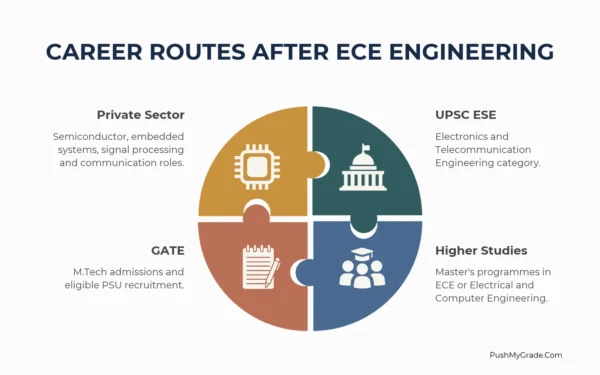
The areas discussed above cover several private-sector career options. An ECE degree can also lead to government jobs and higher studies. Here are three routes you can consider after graduation.
The GATE Route
The Graduate Aptitude Test in Engineering (GATE) is an important exam for engineering graduates who want to pursue postgraduate studies or apply for certain public sector jobs.
IIT Madras is organising the exam. IISc and the IITs examine on behalf of the Ministry of Education’s National Coordination Board.
ECE students sit for the Electronics and Communication Engineering (EC) paper. A qualifying GATE score does not guarantee admission to a postgraduate programme, a scholarship, or a job. PSU recruitment also depends on each organisation’s requirements and selection process.
The ESE Route
The UPSC conducts the Engineering Services Examination (ESE) to recruit engineers for various government services.
The notification states that Category IV covers Electronics and Telecommunication Engineering. This category is relevant for ECE graduates. Category IV opens opportunities in the Indian Radio Regulatory Service, Indian Telecommunication Service, Railway Signalling, and Naval Services.
Higher Studies
After an ECE engineering degree, you can pursue an M.Tech at the IITs and other institutions. GATE is a common route for admission to many postgraduate engineering programmes.
For example, IIT Guwahati offers M.Tech specialisations in:
- Communication Engineering
- Microelectronics, Photonics and RF Engineering
- Power Engineering
- Signal Processing and Machine Learning
- Systems, Control and Automation
- VLSI and Nanoelectronics
If you plan to study abroad, search for programmes under both Electronics and Communication Engineering (ECE) and Electrical and Computer Engineering (ECE). Many US universities use the latter name for departments that cover related subjects.
How to Get into ECE Engineering
You need to pass Class 12 with Physics, Chemistry and Mathematics. Admission takes place through three main routes.
| Admission route | How it works |
|---|---|
| National-level exams | Through JoSAA counselling based on JEE Main and JEE Advanced scores. Qualified candidates are eligible for admission to IITs, NITs, IIITs, and other participating institutions. |
| State-level exams | Many state colleges use their own entrance exams or counselling systems. Examples include MHT-CET in Maharashtra, KCET in Karnataka, TNEA in Tamil Nadu, and TG-EAPCET in Telangana. |
| University entrance exams | Some private universities conduct their own entrance tests for admission. Examples include BITSAT, VITEEE, SRMJEEE, and MET. |
Check the Course before Choosing a College
Some institutes offer ECE as a separate engineering branch. Others include related subjects as specialisations under Electrical Engineering. Check the exact branch name and course structure before applying. For example, IIT Guwahati offers a separate BTech programme in ECE.
Questions Students Ask About ECE Engineering
Is ECE engineering difficult?
ECE can be challenging in the early semesters, when you’ll study topics such as transforms, vector calculus and probability. Many students also find Signals and Systems challenging because it introduces mathematical concepts that can be hard to visualise. Regular practice and solving problems can make these topics easier to understand.
How much can an ECE engineer earn?
Earnings depend on your skills, role, experience and college. For example, IIT Guwahati reported a median BTech ECE package of ₹23.43 LPA in 2024–25. At COEP, the average E&TC package was ₹12.47 LPA in 2023–24. These figures come from two different institutions and reporting years. So, check your preferred college’s placement report for a more relevant picture.
Can ECE graduates get jobs in software companies?
Yes. ECE graduates can apply for software roles if they have the required programming and technical skills. Their background in digital systems, signal processing, and networking can also be useful in certain technology roles. If you’re interested in software development, start building your programming skills and working on projects during college.
Is ECE engineering the same as E&TC?
The two branches largely overlap in subjects and career options. However, course structures can vary by institution. Some colleges, such as R. V. College of Engineering, offer both branches with separate course schemes. Compare their syllabi before choosing.
Do I need to take GATE after ECE engineering?
GATE is useful if you plan to pursue an MTech or apply for PSU recruitment through GATE scores. You can also pursue jobs or other career paths without taking the exam. Qualifying GATE alone doesn’t guarantee admission, a scholarship or a PSU job.