

You press the microphone button on your phone in Kolkata and say, “I’ve arrived. Rohit calls after dinner.” A few seconds later, someone in Bengaluru hears your voice.
That simple voice note passes through several engineering stages. Each stage has a specific role, and electronics and telecommunication engineers help make it all work.
This guide covers the subjects you’ll study, the practical skills you’ll need, how to compare university syllabi, and the career paths you can pursue after graduation.
What is Electronics and Telecommunication Engineering?
Electronics and telecommunication engineering connects two closely related fields. One deals with the electronic circuits that process signals; the other focuses on transmitting those signals from one place to another.
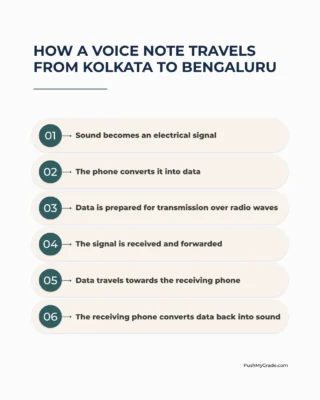
Look at how a voice note travels from your phone in Kolkata to someone in Bengaluru.
- Your voice becomes an electrical signal.
- The phone converts the signal into digital data.
- The phone adds extra data to help detect and correct errors.
- A radio wave carries the data.
- The phone prepares the signal for transmission.
- The antenna sends the signal through the air.
- A cell tower receives the signal and forwards it.
- The network routes the data to its destination.
- The receiving phone converts the data back into sound.
Several technologies work together to make this possible. Electronics involves creating, processing, and reading electrical signals. Telecommunication focuses on transmitting information over long distances. In the graduation, you’ll study how these systems work in detail through subjects.
ECE, E&TC and EXTC: What’s the Difference?
Electronics and telecommunication engineering goes by different names at different institutions.
SPPU in Pune and Shivaji University in Kolhapur use E&TC, ETC or ENTC for Electronics and Telecommunication Engineering. Mumbai University uses EXTC, while BITS Pilani and Thapar use ECE. So, different universities use different titles and abbreviations for the course.
The names also differ across competitive examinations. GATE uses Electronics and Communication Engineering (EC) for its paper. The UPSC uses ET (or E&T) for Electronics and Telecommunication Engineering in the examination.
Most curricula across all three branches often overlap, but the exact syllabus varies by institution. Before choosing a college, download its official syllabus and compare the subjects, laboratory work and electives.
How to Get Into Electronics and Telecommunication Engineering?
Electronics and telecommunication engineering is a four-year undergraduate degree offered as a BE or BTech programme across eight semesters. You need to have studied Physics, Chemistry and Mathematics in Class 12. The minimum aggregate marks vary by college and its admission rules.
| Admission Route | Details |
|---|---|
| After Class 12 | JEE Main, JEE Advanced, state-level entrance exams and institute-level exams such as BITSAT and VITEEE. |
| Diploma holders | May be eligible for lateral entry into the second year, depending on the institution’s rules. |
Electronics and Telecommunication Engineering Syllabus
Most universities follow a common foundation for the programme. The order and names of subjects can vary by university. Check your university’s latest syllabus to see which subjects are taught in each semester.
Years 1 and 2: Building the Foundation
Year 1 covers engineering mathematics, physics, basic electrical and electronics, C programming, and engineering graphics. Mathematics is particularly important. Calculus and linear algebra return as Fourier transforms in the signals course and as Maxwell’s equations in electromagnetics.
In some colleges, electromagnetics generally arrives in Semester 3, and sometimes it appears in Semester 5.
Year 2 builds on these fundamentals with network theory, analogue circuits, digital circuits, linear integrated circuits (ICs), signals and systems, control systems, introductory communication, and microcontrollers.
Year 3: Core Subjects and Communication Systems
Year 3 builds on the fundamentals and introduces more specialised subjects. Common subjects include Digital Communication, Electromagnetic Field Theory, Antennas and Wave Propagation, Computer Communication, Digital Signal Processing (DSP) and Embedded Systems and Microcontrollers. Students may also begin choosing electives based on their interests.
Year 4: Specialisation and the Final Project
The final year explores advanced topics and allows students to apply their knowledge through a project. Subjects may include VLSI Design, Microwave Engineering, Optical Communication, Mobile Communication, Wireless Networks, Embedded Systems and CMOS Mixed-Signal VLSI.
The final-year project lets you apply what you have learned. Choose a project that produces a working prototype, measurable results or a simulation with real results. This gives you practical work to discuss in interviews.
Read More: BTech Mechanical Engineering: Courses, Careers & Scope
3 Subjects That Make Your Foundation
These three subjects form the foundation for many advanced topics in electronics and telecommunication engineering.
Signals and Systems
You’ll learn key concepts such as convolution, Fourier transforms, Laplace transforms and sampling. They also appear in digital signal processing (DSP), communication systems, control systems, and image processing. Start by solving problems by hand, and then use Python or MATLAB to check your understanding.
Electromagnetic Field Theory
This subject connects vector calculus with the physics of electric and magnetic fields. The concepts can take time to understand, but they are useful in antenna design, microwave engineering, optical fibre communication, and high-speed circuit-board design.
Digital Communication
This subject covers modulation, noise, error probability, and information theory. These concepts explain how digital information travels through communication systems.
Skills to Build Beyond the Syllabus
The syllabus covers the basics, but most electronics and telecommunications engineering roles also need practical skills. These four skills are worth acquiring in college.
C and embedded C
Write code and run it on a microcontroller board to understand how hardware and software work together.
Python or MATLAB
Use these tools to analyse signals, create plots, and run basic simulations.
Verilog or VHDL
Learn digital design and practise implementing circuits on an FPGA board. These skills are useful for chip-design roles.
Circuit design tools
Use LTspice to simulate circuits and KiCad to design circuit boards. If your college provides access, explore industry-standard electronic design automation (EDA) tools for chip design.
The government’s Chips to Startup (C2S) programme provides chip-design tools to various academic institutions, and SCL Mohali fabricates chips designed through the programme. Ask your department whether your college participates. You can also check the official programme website for the list of institutions.
Career Paths after Electronics and Telecommunication Engineering
Electronics and telecommunication engineering offers many career paths. You can work on communication networks, design electronic chips, build embedded systems, join a manufacturing team or pursue careers in defence and research. Your opportunities depend on your skills, projects, and roles.
1. Telecommunications and Network Engineering
Telecom operators such as Jio, Airtel, Vodafone Idea, and BSNL, along with other network equipment companies, need engineers to build and maintain communication systems.
Work can include radio-frequency (RF) planning, network performance, optical communications, testing, and network integration. As mobile networks evolve, engineers can also explore research into next-generation wireless technologies.
2. Semiconductor and Chip Design
Semiconductor engineering focuses on the chips that power phones, computers, vehicles, and electronic equipment. Career paths include digital design, design verification, physical design, analogue and mixed-signal design, and chip testing.
These positions often require additional skills in digital electronics, Verilog, timing analysis, and electronic design automation (EDA) tools. Semiconductor manufacturing and packaging also create opportunities in process engineering, testing, and reliability.
3. Embedded Systems, IoT and Automotive Electronics
Embedded systems combine hardware and software. They power devices such as smart meters, industrial machines, vehicles and medical equipment. The Internet of Things (IoT) extends this idea by connecting devices so they can collect and exchange data.
Field engineers work with microcontrollers, firmware, sensors, circuit boards and device communication. Automotive electronics is another related area that covers electronic control units, vehicle sensors and communication systems.
4. Electronics Design and Manufacturing
Engineers can work in product development, circuit design, quality assurance, production, testing, and process engineering. This path suits students interested in building electronic devices, finding faults, and improving product performance or reliability.
5. Defence, Space and Broadcasting
ISRO, DRDO, and Bharat Electronics offer opportunities in radar, satellite communication, navigation, radio systems, and other electronic technologies.
Typical work includes designing equipment, testing communication systems, or developing technologies for specialised applications. Recruitment routes and eligibility vary by each organisation and post.
6. Government Engineering Services
Electronics and telecommunication graduates can join government engineering roles through the Engineering Services Examination (ESE) and other organisation-specific recruitment processes.
You can work in telecommunications, railway signalling, radio regulation, technical administration, or electronic systems. Eligibility, vacancies, and selection procedures vary by role.
7. Higher Studies and Research
You can go for postgraduate study and research after graduation. You can choose specialised areas such as VLSI design, embedded systems, communication systems, signal processing, RF and microwave engineering, or optical communication.
In India, GATE is one route to eligible postgraduate programmes and certain research opportunities. You can also choose an MS abroad for advanced study or research.
8. Software and Computing Roles
Electronics and telecommunication graduates can also move into software and computing careers. Relevant areas include embedded software, network programming, signal-processing software, test automation and machine learning applications involving sensor data.
These roles require stronger programming skills. If software interests you, build projects and practise the languages and tools required for your chosen role during college.
Is It the Right Branch for You?
Electronics and telecommunication engineering may suit you if you relate to most of the following questions:
1. Do you enjoy finding out why a circuit doesn’t work and how to fix it?
2. Are you willing to learn the mathematics in subjects such as signal processing and electromagnetics?
3. Would you enjoy working with electronic components, circuit boards and antennas?
4. Are you curious about how phone calls and wireless communication work?
If you’re more interested in building software applications, Computer Science may be a good fit. If you are more interested in electrical power systems and machines, Electrical Engineering might be better.
You don’t need to know everything before you come in. Curiosity and a willingness to learn matter more than any previous electronics experience.
Read More: BTech Computer Science and Engineering: Courses, Careers & Scope
Before You Choose a College
Before choosing an electronics and telecommunication engineering programme, ask the department these four questions:
What practical labs are available?
Ask about FPGA boards, digital signal processing (DSP) kits, RF or microwave equipment, and embedded-system boards. Find out how many students share each piece of equipment.
Does the college provide access to chip-design tools?
Check whether it participates in the Chips to Startup (C2S) programme or offers access to other relevant design tools.
What projects do students build?
Review recent final-year projects to see whether students work on hardware, software or a combination of both.
Which specialisations are available?
Ask whether the department offers subjects in VLSI design, embedded systems and RF engineering, and whether these electives actually run.
Making the Most of Your Four Years
You don’t have to learn everything all at once. Each year, build your knowledge, get hands-on experience and explore the areas that interest you.
| Year | What To Do | Details |
|---|---|---|
| Year 1 | Build the foundations | Learn basic programming and get comfortable with fundamental electronics. Try a small project using a sensor or microcontroller. |
| Year 2 | Explore the tools | Practise circuit simulation and basic signal analysis. If your college has the facilities, try digital design using Verilog and an FPGA board. |
| Year 3 | Choose an area to explore | Try a project in telecommunications, chip design, embedded systems or another area that interests you. Build relevant skills and look for internships or research opportunities. |
| Year 4 | Develop your direction | Complete a substantial final-year project and prepare for your next step, whether that is campus placement, a specialised technical role, postgraduate study or eligible government recruitment. |
Treat this as a flexible roadmap, not a fixed checklist. Your college curriculum, available facilities and interests will shape what you can do in each year.
Frequently Asked Questions
What does an electronics and telecommunication engineer do?
An electronics and telecommunication engineer designs, tests and improves electronic devices and communication systems. Their work may involve electronic circuits, wireless networks, embedded systems, semiconductor chips, signal processing or other specialisation roles.
What is the difference between ECE and E&TC?
The names vary by university. ECE and E&TC generally cover similar curricula, with minor differences in elective courses or lab work.
What subjects are taught in electronics and telecommunication engineering?
The course covers engineering mathematics, electronic circuits, digital electronics, signals and systems, communication systems, electromagnetic theory, microcontrollers, and signal processing. The exact subjects vary by university and semester.
What can I do after electronics and telecommunication engineering?
Graduates can pursue careers in telecommunications, semiconductor design, embedded systems, electronics manufacturing, defence, software and research.
Which companies hire ECE and E&TC graduates?
Companies in Semiconductors, telecommunications, electronics, networking and software hire ECE graduates for suitable roles. These include Qualcomm, Intel, Texas Instruments, Samsung, Ericsson, Nokia, Cisco, Jio and Airtel. IT companies such as TCS, Infosys and HCLTech also recruit graduates for software and related roles.
Is electronics and telecommunication engineering good for the future?
Electronics and telecommunication engineering offers opportunities in semiconductor design, telecommunications, embedded systems, electronics manufacturing and wireless communication. Graduates can also explore software careers or higher studies. Your prospects depend on the skills, the specialisation, and the opportunities in your target field.